Measuring and Adding Sound Levels

Noise-induced hearing loss, or NIHL, is one of the most common occupational diseases. This doesn’t occur overnight, but the effects are noticed gradually over many years of unprotected exposure to high sound levels. This is 100% preventable! Through proper engineering controls and personal protective equipment (PPE), NIHL can be prevented. It is irreversible, so once the damage is done there’s no going back. OSHA standard 19 CFR 1910.95(a) states that protection against the effects of noise exposure shall be provided when the sound levels and exposure time exceed those shown in the table below.

OSHA Chart

Intensity of the sound pressure level is expressed in decibels (dB). The scale is logarithmic, a 3 dB reduction cuts the sound level in half. A 10 dB reduction decreases it by a factor of 10, and a 20 dB reduction decreases the sound level by a factor of 100. To calculate the dB level, we use the following formula:

Sound SPL

Where:

L – Sound Pressure Level, dB

P – Sound Pressure, Pa

Pref – reference sound pressure, 0.00002 Pa

For example, normal conversation has a Sound Pressure of .01Pa. To calculate the dB level:

dB = 20 log10 (.01Pa/.00002Pa)

 = 54 dB

When designing a new blowoff process, it’s important to consider the sound levels produced before implementation. EXAIR publishes the sound level for all of our products for this very reason. If you’re implementing multiple nozzles, you’ll need to add the sound levels together. To do so, we use the following formula:

Sound Addition

Where:

L1, L2… represent the sound pressure level in dB for each source

A customer was using ¼” open ended copper tubes for a blowoff application removing trim after a stamping operation. They had a total of (4) tubes operating at 80 PSIG. Not only were they VERY inefficient, but the sound level produced at this pressure was 94 dBA. To calculate the sound level of all (4) together we use the above formula:

L = 10 x log10(109.4+ 109.4 + 109.4 + 109.4)

L = 100 dB

At this sound level, permanent hearing loss begins to occur in just two hours of unprotected exposure. We recommended replacing the loud and inefficient copper pipe with our 1” Flat Super Air Nozzle, Model 1126. At 80 PSIG, the 1126 produces a sound level of just 75 dBA.

L = 10 x log10 (107.5 + 107.5 + 107.5 + 107.5)

L = 81 dB

At almost a 20 dB reduction, that’s nearly 100x quieter! Don’t rely on just PPE to keep your operators safe from NIHL. Replacing loud inefficient blowoff methods with EXAIR’s Intelligent Compressed Air Products will take it one step further in ensuring your creating a safe working environment for your employees.

Tyler Daniel
Application Engineer
E-mail: TylerDaniel@EXAIR.com
Twitter: @EXAIR_TD

Limiting Noise Exposure with Mufflers for Compressed Air

Mufflers come in many shapes and sizes. Each with their own benefits.

If you have ever walked into a manufacturing facility and heard the hiss or even worse the banshee scream of compressed air being exhausted to ambient, whether it be from a cylinder discharge, a timed drain going off, or a bypass valve being activated, they all could be hushed with a muffler. A muffler for compressed air comes in several shapes and sizes. EXAIR offers four separate types from stock to help attenuate the noise disruption within your facility.

The OSHA standard for allowable noise exposure is 29 CFR-1910.95(a) and outlines the number of hours per day any individual can be exposed to a particular noise level. These noise levels are expressed in decibels (dbA).

Hearing loss is the best known, but not the only, ill effect of harmful noise exposure. It can also cause physical and psychological stress, impair concentration, and contribute to workplace accidents or injuries.
Reclassifying Mufflers attenuating the exhaust of a pneumatic cylinder.

The first type I would like to showcase are the Reclassifying Mufflers. These are ideal for cylinder exhausts or valves which commonly contain an oil mist within the air stream which can easily contaminate the surrounding area. The patented design of the removable element separates oil from the exhausted air so virtually no atomized oil is released into the environment. They also attenuate the exhaust noise level up to 35 decibels. The filter element helps the exhaust to meet the OSHA Standard 29 CFR 1910.1000, a worker’s cumulative exposure to oil mist must not exceed 5 mg/m³ by volume in any eight hour shift of a forty hour work week.

The chart below helps to properly size the Reclassifying Muffler for a pneumatic cylinder. One key to proper installation of these mufflers is they must be installed vertically in order to properly trap and drain the oil.

Reclassifying Muffler Quick Pick Chart
Sintered Bronze mufflers are excellent choices for tight installation locations and are easily sized.

The next type of muffler to discuss are the Sintered Bronze Mufflers that are offered in ten different sizes. These are an excellent low cost solution which easily install into new or existing ports. Each size is designed to provide minimal back pressure and restriction for the individual port size. The quick pick chart below helps to easily select the correct size for attenuating the exhaust of a pneumatic cylinder. One key difference between these and the Reclassifying Mufflers is, these do not have to be oriented vertically as they do not collect the oil out of the exhaust air.

undefined

The model 3913 – 3/4″ NPT Straight Through Muffler

If the process air needs to be directed or plumbed away from the operator then the Straight Through Mufflers are the ideal selection as they offer an NPT threaded inlet and exhaust. They are available in three standard NPT sizes from stock. These mufflers can be installed in any orientation and work well with our Vortex Tubes to help pass the cold air through while lowering the operating sound level of the tube. The average noise reduction of the Straight-Through Mufflers is 20 dB. This can easily reduce the noise level of an operation to below the OSHA standard requiring hearing protection for operators in the area.

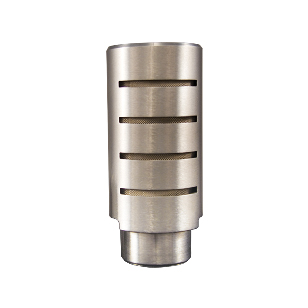
The model 3903 Heavy Duty Muffler

The final option for mufflers from EXAIR are the Heavy Duty Mufflers. These are available in two sizes from stock and are constructed of corrosion-resistant aluminum with a stainless steel internal screen. These can be installed in any orientation and are ideal for protecting exhaust ports from contaminants that may clog or damage the device they are attached to. The typical noise reduction from installation is 14 dB with these mufflers.

These are available in two sizes from stock and are constructed of corrosion-resistant aluminum with a stainless steel internal screen. These can be installed in any orientation and are ideal for protecting exhaust ports from contaminants that may clog or damage the device they are attached to. The typical noise reduction from installation is 14 dB with these mufflers.

To summarize, EXAIR offers a multitude of options when it comes to lowering sound levels in operation areas that are caused by exhausted compressed air. Each of the mufflers discussed above are shipped same day from stock to meet your immediate need. If you are unsure of which muffler to use for your application, feel free to contact an Application Engineer.

Brian Farno
Application Engineer
Ph. 1-513-671-3322
BrianFarno@EXAIR.com
@EXAIR_BF

Brian Farno
Application Engineer
BrianFarno@EXAIR.com
@EXAIR_BF

Sound Power Vs Sound Pressure

sound-level-comparison
EXAIR Intelligent Compressed Air Product dBA ratings as compared to other sounds

When trying to explain or state a number associated with how loud a sound or noise is it can be somewhat confusing or at the very least, ambiguous.  This blog will help to make it clear and easy to understand the difference between Sound Power and Sound Pressure.

Sound Power is defined as the speed at which sound energy is radiated or transmitted for a given period of time.  The SI unit of sound power is the watt. It is the power of the sound force on a surface of the medium of propagation of the sound wave.

Sound Pressure is the sound we hear and is defined as the atmospheric pressure disturbance that can vary by the conditions that the sound waves encounter such as furnishings in a room or if outdoors trees, buildings, etc.  The unit of measurement for Sound Pressure is the decibel and its abbreviation is the dB.

I know, the difference is still clear as mud!  Lets consider a simple analogy using a light bulb.  A light bulb uses electricity to make light so the power required (stated in Watts) to light the bulb would be the “Sound Power” and the light generated or more specific the brightness is the “Sound Pressure”.  Sound just as with the light emitting from the bulb diminishes as the distance increases from the source.  Skipping the math to do this, it works out that the sound decreases by 6 dB as the distance from the sound source is doubled.  A decrease of 3dB is half as loud (Sound Pressure) as the original source.  As an example sound measured at 90 dB @ 36″ from the source would be 87dB at 54″ from the sound source or 84dB at 72″.

We at EXAIR specialize in making quiet and efficient point of use compressed air products, in fact most of our products either meet or exceed OSHA noise standards seen below.

OSHA Noise Level

EXAIR also offers the model 9104 Digital Sound Level Meter.  It is an easy to use instrument for measuring and monitoring the sound level pressures in and around equipment and other manufacturing processes.

If you have questions about the Digital Sound Level Meter, or would like to talk about any of the quiet EXAIR Intelligent Compressed Air® Products, feel free to contact EXAIR or any Application Engineer.

Steve Harrison
Application Engineer

Send me an email
Find us on the Web 
Follow me on Twitter
Like us on Facebook


Sound – It Adds Up! How to Calculate Decibel Levels

Keeping noise levels in check and at safe levels is very important to ensure employee safety and well being.  OSHA (the Occupational Safety and Health Administration) through standard 29 CFR-1910.95(a) has studied the situation and set Maximum Allowable Noise Exposure limits in Hours per Day based on the Sound Level, in dBA, of exposure.

For existing processes, a Digital Sound Meter is a valuable tool to measure the sound level to ensure that the source of loud noises can be quickly identified and isolated for immediate corrective action.

For new processes, or changes to an existing process, it is important to estimate the sound level prior to installation and start-up, so that precautions can be taken as needed.

For example, let’s say we are going to add a blow off station to clean off a part on a conveyor to improve the process and increase the throughput.  A typical set-up might be a 12″ Super Air Knife (model 110012) blowing off the top and a pair of Super Air Nozzles (model 1100) to blow off the sides.

SAK and ASAN
12″ Super Air Knife and Super Air Nozzle

If we look at the performance data for the (2) different blow off devices, we find that the Super Air Knife is rated at 69 dBA and the nozzles at 74 dBA, when operated at 80 PSIG of compressed air supply.

SAK and ASAN

When asked, “what is the sound level for (1) of the knives, and (2) of the nozzles” a little Acoustic Engineering is in order. The decibel scale is logarithmic, and determining the total sound level when all (3) devices are in operation is not as easy as adding up the three sound level values (which would equal 218 dBA, way off the charts!).  Thankfully, both the actual sound level and the numerical value are determined another way.  I’ll spare you a lot of the math but the equation is as below.

Capture

… where SL1, SL2, SL3, … are the sound levels in dBA of the each sound makers, for as many that are being combined (in our example SL1 = 69, SL2 = 74 and SL3 = 74)

Plugging in the numbers into the equation, the combined sound level works out to be a quiet 77.65 dBA — well within the OSHA limit for exposure for a full 8 hour period.

To discuss your application and how an EXAIR Intelligent Compressed Air Product can make your process better and quieter, feel free to contact EXAIR and myself or one of our other Application Engineers can help you determine the best solution.

Brian Bergmann
Application Engineer

Send me an email
Find us on the Web 
Like us on Facebook
Twitter: @EXAIR_BB