
When The Obvious Answer, Isn’t

Certain EXAIR products are designed for specific applications. We’ll still get calls from folks who want to use them in situations different than what they’re intended. For instance:

*Reversible Drum Vacs for use with volatile liquids. Due to the very real risk of ignition, we do not specify our Industrial Vacuums for use with flammables. This is a case where we can’t help, but we do know some suppliers of suitable equipment for these situations.

*Cabinet Cooler Systems for anything but a totally enclosed electrical cabinet. Oftentimes, these alternate applications are really just in need of a reliable, consistent source of cold air, which can be more properly addressed with a Cold Gun, Adjustable Spot Cooler or Mini Cooler.

*Speaking of those particular Spot Cooling Products, we’re able to help many callers who inquire about these by simply pointing them in the direction of a Vortex Tube: they’re lightweight, compact, and with standard NPT connections for compressed air supply, cold flow, and hot exhaust, you can hook them up to darn near anything you want.

Coat_Conserve_Cool_Convey_Clean
A broad range of products, each with a broad range of applications!

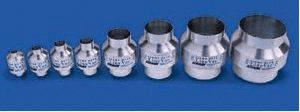
Like the Vortex Tubes, a good many of our products’ designs afford adaptability to a wide range of uses. I submit, for your reading pleasure, these two wildly different Line Vac applications:

*A manufacturer of electrical connector devices needed to move small parts from a mass production line to their assembly area. A Model 6084 2” Aluminum Line Vac and our 6934-20 2” Clear Reinforced PVC Conveyance Hose (20ft Length) was purchased and installed. They operate it as needed to empty the production bin and fill the assembly bin; simple as that. This is a “textbook” job for a Line Vac.

*A service company that specializes in large compressors & engines was looking for a compact & mobile device to evacuate exhaust gases. This is normally where we start talking about Air Amplifiers (and we did) but their calculations called for more suction head than the Air Amplifiers will generate. Their calculations were right, and they’re putting Model 6060 ¾” Stainless Steel Line Vacs on all their service trucks. So, a “textbook” job for an Air Amplifier was actually a better fit for the Line Vac.

And speaking of “textbook” applications that take unexpected turns, another caller needed help with a “pick and place” operation that he’d purchased a small E-Vac Vacuum Generator and Vacuum Cup for. He needed to move these small media filters, one at a time, from a stack, into their product. Try as they might, they could NOT pick up just one of these pieces from the stack, which was about 3” in diameter, and about the consistency of a coffee filter….which was exactly what I used to replicate the application in the Efficiency Lab. I couldn’t just pick one up with the E-Vac either, so I tried to just use the open suction end of a Line Vac – even with the compressed air supply valve cracked open as low as I could manage, it still wanted to pick up 2 or 3 at a time. We’ve got one other product that generates a vacuum, and, crazy as it sounds, I attempted to apply our Air Amplifier in a pick-and-place situation. And it worked: with the supply valve cracked open (it wasn’t even registering flow to the smallest division on our rotameter flow meter,) the Model 120020 ¾” Super Air Amplifier was able to consistently pick up one (and only one) coffee filter at a time. So our “textbook” job for an E-Vac was solved by an Air Amplifier.

Sometimes, what seems to be the obvious solution, isn’t. With a little discussion, and possibly experimentation, though, the right answer will generally reveal itself. If you think this might be where you’re at with your application, give us a call. I can’t wait to see what happens!

Russ Bowman
Application Engineer
Find us on the Web
Follow me on Twitter
Like us on Facebook
2 EXAIR Solutions For A Single Plastic Injection Molding Process

I was recently contacted by a manufacturer of precision gearing components looking for assistance in their plastic injection molding process. Their needs were two fold as they were looking for a more efficient way of delivering the plastic pellets to the hopper and a way to remove fine particulate and eliminate the static on the gears after the molding process.

For the plastic pellets application, they were having an operator manually deliver the pellets to the feed hopper. I recommended they use our Light Duty Line Vac. The Light Duty Line Vac uses less compressed air than our other air operated conveyors and are ideal for moving material a short distance. We offer sizes from 3/4″ up to 6″ in aluminum construction. In this particular application, since the customer was only looking to move a few pounds a minute approximately 6′ vertically, I recommended our 2″ Light Duty Line Vac.

Light Duty Line Vac
Low cost, reliable way to move a small volume of material a short distance.

In the injection molding application, after the gears are molded they drop to a 12″wide conveyor where they travel side by side and pass under a print head. The customer currently had an operator that was using a blow gun to blow off any residual plastic fines but noticed they weren’t able to remove all of the particulate which caused irregularities when they tried to print their identification markings.

I recommended they use our 12″ Super Ion Air Knife in this process. The Super Ion Air Knife provides a high velocity, laminar sheet of ionized airflow across the entire length of the knife. Operating at 80 PSIG, it produces a velocity of 11,800 feet per minute (6” away), consumes only 2.9 SCFM per inch of knife and is capable of dissipating 5kV in 0.18 seconds. This would cover entire width of the conveyor, ensuring they are treating both gears, providing the needed static elimination and blow off to carry the fines away.

Super Ion Air Knife
Super Ion Air Knife – Available from 3″ up to 108″

For help with your application, please give us a call, we’d be glad to help.

Justin Nicholl
Application Engineer
justinnicholl@exair.com
@EXAIR_JN

Here’s what the Freon-based Air Conditioner Manufacturers Won’t Tell You

Many times when we are asked to make a comparison of our Cabinet Cooler Systems to Freon-based Cooling Systems for electrical panels, the customer only wants to know what the energy consumption will be as this is their only focus.

But what most Freon cooling system owners don’t seem to be concerned about, until it is too late, is the maintenance headache that Freon-based cooling systems present to their maintenance schedule, personnel and production schedule.  Below is just one example of what a typical industrial Freon-based Cabinet Cooling system user must go through each month just to keep their panels cool enough to keep production going.

A Freon cooling system user contacted me about a problem they have with their existing units. The setting is a machine shop located somewhere in Indonesia where the temperatures can exceed 40°C and Relative Humidity Levels around 85%. They have 4 units keeping a bank of panels cool for a transfer line which includes CNC machining centers. Photo showing coolers installed below.

AC 3 and 4 Cleaning (6)
Freon Panel Coolers on Transfer Line

The problem they have is that the dirt, dust and coolant which are present, deposit on the internal workings of the Freon Coolers, reducing their cooling efficiency to a point where over-heat condition becomes a problem. This occurs so frequently that the customer is having to completely remove and clean all 4 Freon cooling units for a full 8 hour shift, 1 day every month. That’s almost 3 weeks of lost production per year!  Obviously, that is a huge drag on the customer’s productivity.

IMG_1708
Dirt and Coolant collect on inside reducing cooling efficiency

And so, a certain amount of buyer’s remorse pervades for those folks who own and have to maintain Freon system just to keep their production up and running.

So, what does EXAIR offer?  EXAIR’s Cabinet Cooler Systems offer the customer freedom from all of this downtime, maintenance and loss of productivity. How?

  1. We are selling reliability with our Cabinet Cooler systems. No maintenance is required on the cooler system or on the cabinet to which it is installed. Because there are no moving parts to wear out. A simple, periodic check on a compressed air filter element is all that is necessary.
  2. We are selling the fact that our Cabinet Cooler Systems maintain a positive pressure on the customer’s panel. This condition keeps all of this dirt, coolant spray and any other contamination out due to the positive pressure that is placed on the panel while the Cabinet Cooler System is operating. Air is always moving from inside the panel to the outside, so dust, dirt and other debris never has a chance to enter through vents or other openings.
  3. We are selling longevity with our Cabinet Cooler Systems. Because there are no moving parts, the life span of EXAIR Cabinet Cooler Systems is in the range of 20+ years. The Freon based systems operating under these mildly harsh conditions will last 5 years at most. So in the life span of one EXAIR Cabinet Cooler, the Freon cooling system user will have been through at least 4 different units during that time. And still have all the monthly maintenance hassle come along with it.

The general point I wish to make with this real-world example is to think about the total cost of ownership when considering your next panel cooling system purchase. It is not all about energy consumption. Energy use is important, but by no means should that be your only consideration when deciding on what type of panel cooling system is right for you as the person charged with keeping the overall production line up and running.

Neal Raker, International Sales Manager
nealraker@exair.com
@EXAIR_NR

Reliability – EXAIR Cabinet Cooler Systems Have It

Today, I’m working on a informal video for you our lovely readers, and the video editing software can be quite cumbersome on the old CPU. I’m reminded of the old joke about Bill Gates and GM. Bill Gates says, “If Microsoft built a car it would cost $25 and get 1,000 miles to a gallon.” The executive of GM reads this in the paper and issues the following Press statement. “If GM developed technology like Microsoft, the car would crash twice a day.” All I have to say to either company is now I drive to work with a bad tire sensor in my car and every time I try and edit a video, I see a blue screen and need to reboot.

*Fine Print: I drive a car made in Korea and edit video with a software company other than Microsoft. The joke is just a joke not a reflection on either Microsoft or GM.

Today I wish I had a product that worked great everyday that I needed it. A product that require very little maintenance and I could count on to work right the first time every time. Something time tested, easy to install and innovative. I know of a product with these criteria – A Cabinet Cooler System – which is used to keep the internal temperature of your electrical cabinets at an optimal working temperature when dealing with components which heat the inside or when seasonal temperature increases cause additional internal heat buildup.

Cabinet Cooler Family
Cabinet Cooler Family (From Left To Right Small NEMA 12 Cabinet Cooler, Large NEMA 12 Cabinet Cooler, or Large NEMA 4X Cabinet Cooler)

A Cabinet Cooler is Vortex Tube based cooling product that runs on compressed air. The Cabinet Cooler Systems can cool up to 5,600 BTU/Hr. It has no moving parts to wear out. It will lower your compressed air temperature by 50 degrees F. The cabinet cooler also creates a positive pressure on the cabinet to prevent dust from entering the cabinet. We have varieties of NEMA 12 units to resist dust and oil intrusion and NEMA 4 units that resist, water, dust and oil intrusion. NEMA 4X units combat corrosion, water, dust and oil. The Cabinet Cooler Systems are versatile compressed air coolers that will work in harsh conditions.

The alternative to cabinet coolers have a variety of problems. During the heat of the summer fans are only able to pull in hot, humid, and dirty air. The hot plant air does not have the same cooling ability as cool winter air. In a dirty environment the fans must be filtered to prevent dust and dirt building up inside the cabinet preventing heat transfer. The motors on fans will need to be replaced. Air Conditioners have don’t rely on the ambient air temperature, but dust and dirt are pulled into their filters which can clog and lead to costly maintenance or replacement. Cabinet Coolers have no moving parts and don’t really on ambient temperature, so they are a much better system for hot, industrial environments.

EXAIR offers an online sizing guide for your convenience. Fill one out today, so you can avoid costly repairs on your electronic equipment.

Dave Woerner
Application Engineer
@EXAIR_DW
DaveWoerner@EXAIR.com