EXAIR’s EFC is THE Way to Save Compressed Air

waste

Compressed air is the most expensive utility for most industrial facilities. The energy costs associated with the generation of compressed air can be very high. Because of this, EXAIR manufactures a wide range of products geared towards reducing your overall compressed air consumption.

The best way to save compressed air is to simply turn it off when it’s not being used. This might seem pretty simple, but there may be processes in your facility where this couldn’t be achieved by just turning a valve. In applications where product is traveling along a conveyor, and must be dried, cooled, or blown off, there is likely some spacing in between the parts. It isn’t necessary to keep the blowoff running constantly if there’s periods of intermittent spacing. To help reduce the overall load on the air compressor, implementing a solution to shut the air off in between each part can have a dramatic impact. EXAIR’s Electronic Flow Control, or EFC, is designed to improve efficiency by reducing overall compressed air usage. It utilizes a photoelectric sensor that detects when the part is present. When it’s not, it triggers a solenoid valve to close and shut off the compressed air supply.

efcapp


Let’s take a look at an example that shows just how much air (and $$) an EFC can save. We had a manufacturer of car bumpers that was using a Model 112060 60” Super Ion Air Knife supplied at 40 PSIG to remove dust prior to a painting operation. The bumpers were moving at about 10’/minute and had 1’ of spacing in between each part. The bumpers are only under the blowoff for 10 seconds, while 6 seconds passed with no part present. With a (3) shift operation, this translates to 1,440 minutes of nonstop compressed air usage per day.

A 60” Super Ion Air Knife will consume 102 scfm at 40 PSIG. Their current method was using a total of 146,880 SCFM.

102 SCFM x 1,440 minutes = 146,880 SCF

With the EFC installed, the air was shut off for 6 seconds reducing the airflow by 37.5%. With the EFC installed, the compressed air consumption per day was reduced to 91,800 SCF.

146,880 SCF x .625 = 91,800 SCF

As a general rule of thumb, compressed air costs $0.25/1,000 SCF. By saving 55,080 SCF per day, this manufacturer was able to save $13.77 per day. Since this was a 24 hour/day shift running 7 day/week, total savings for the year came in at $5,012.28. This easily recoups the costs of the EFC and then begins to pay you in less than 6 months.

55,080 SCF x ($0.25/1,000 SCF) = $13.77

$13.77 x 7 days/week x 52 weeks/year = $5,012.28

The EFC models available from stock can accommodate flows up to 350 SCFM. For applications requiring more compressed air, EFCs with dual solenoids are also available. If you have an application in one or more of your processes where intermittent compressed air use could help save you money, give us a call. We’d be happy to take a look at the application and help determine just how quickly the EFC could start paying YOU!

Tyler Daniel
Application Engineer
E-mal : TylerDaniel@Exair.com
Twitter: @EXAIR_TD

Monitor Your Compressed Air System With EXAIR’s Digital Flowmeters

A topic that we’ve talked about here on the EXAIR blog discusses the costs of compressed air and how to use it more efficiently. How can you determine the costs of your compressed air? The first step you’ll need to take is to quantify the flow. In order to do that you’ll need a measurement tool such as the EXAIR Digital Flowmeter.

dfm_sizes
EXAIR’s family of Digital Flowmeters

The Digital Flowmeter is available from stock for use on Schedule 40 pipe with sizes ranging from ½”-4” I.D. Sizes up to 6” for Schedule 40 and ¾”-4” for copper pipe are also available. With a digital readout display, it’s easy to accurately monitor your compressed air usage throughout the facility. Creating a baseline of your usage will allow you to understand your compressed air demand, identify costly leaks, and replace inefficient air products.

The Digital Flowmeter installs in minutes with help from a drill guide and locating fixture to assist in mounting the Digital Flowmeter to the pipe. Two flow sensing probes are inserted into the drilled holes in the pipe. The meter then seals to the pipe once tightened. There is no need to cut, weld, or do any calibration once it is installed. With blocking rings also available, installation can be permanent or temporary.

The newest addition to this product line is the Digital Flowmeter with wireless capability. Using a ZigBee® mesh network protocol, data is transmitted to an Ethernet connected gateway. This allows you to mount the Digital Flowmeter in areas that you may not be able to easily access and wirelessly monitor and graph the usage with the EXAIR Logger software. Take a peek at this video blog for a demonstration of the use of a wireless Digital Flowmeter software to compare an open pipe to an engineered Air Nozzle.

wirelessdfmpr2_1670x574

In addition to communicating wirelessly with the gateway, the Digital Flowmeters can “piggyback” off of each other to extend their range. Each meter has a range of 100’. Using multiple Digital Flowmeters within the same ZigBee® mesh network, data can be passed from meter to meter to extend the distance over which the meters can operate. These can be installed on each major leg of your compressed air system to continuously monitor usage throughout the facility.

If you’d rather go with a hard-wired data collection method, the Digital Flowmeter is also available with a USB Data Logger. Simply remove the Data Logger from the Digital Flowmeter and connect it to the USB port of your computer. The data can then be viewed directly in the accompanying software or exported into Microsoft Excel.

dataloggerPRce_559wide
Digital Flowmeter w/ USB Data Logger installed

If you’d like to get a clear view of your compressed air usage, give us a call. An Application Engineer will be happy to work with you and get the proper Digital Flowmeters installed in your facility!

Tyler Daniel
Application Engineer
E-mail: TylerDaniel@exair.com
Twitter: @EXAIR_TD

EXAIR Super Air Nozzles: 38 Day ROI Saves Money

Blow off station

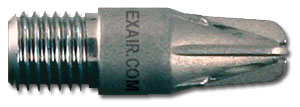
I received an email from an engineer that was looking at our Super Air Nozzles.  They currently were using four blow-off lines that were made from 6mm ID copper tubes.  (Reference picture)  The system was designed to blow out holes after machining.  The engineer was in charge of the task of optimizing 25 machining stations similar to this one.  He was familiar with EXAIR products from his previous employment, and he recognized the waste of compressed air by using open pipe.  He purchased four Nano Super Air Nozzle, model 1110SS, for a trial.  He was impressed with the performance, the low sound level, and the engineered design in safety.  But, for upper management in his company, he had to show a cost savings in order to change all the stations in the facility.  He asked me to help him in calculating the compressed air savings.

He gave me some additional details about their application.  He was using the compressed air about 30% of the time throughout an 8 hour day at a pressure of 80 PISG.  He wanted to present the savings per day, week, and year as well as the payback period in his evaluation.  I have performed many of these calculations for other customers and was happy to help.  It is sometimes easier to speak in terms of savings, as everyone can relate to money, especially management.  (The numbers below can be adjusted to match your application and blow-off devices).

Knowns:

Cost of compressed air: $0.25/1000 cubic feet of air (this is based on $0.08/Kwh of electrical cost)

Flow: 1110SS Nano Super Air Nozzle – 8.3 SCFM at 80 PSIG

Flow:  6mm ID copper tube – 42 SCFM at 80 PSIG


The difference in compressed air flows from a 6mm tube to the Nano Super Air Nozzle is (42 SCFM – 8.3 SCFM) = 33.7 SCFM.  At a 30% duty cycle, we get 33.7 SCFM * 0.3 = 10.2 SCFM (cubic feet/minute) of additional compressed air being used.

Per day, the additional amount of compressed air wasted is:

10.2 cubic feet/minute * 60 min/hr * 8 hr/day (one shift) = 4,896 cubic feet per day.

Per week, the additional amount of compressed air wasted is:

4,896 cubic feet/day * 5 days/week = 24,480 cubic feet per week.

Per year, the additional amount of compressed air wasted is:

4,896 cubic feet/day * 250 days/year = 1,224,000 cubic feet per year.


With the cost to make compressed air at $0.25/1000 cubic feet, we have the following:

4,896 cubic feet/day * $0.25/1000 cubic feet = $1.22 per day

24,480 cubic feet/week * $0.25/1000 cubic feet = $6.12 per week

1,224,000 cubic feet/year * $0.25/1000 cubic feet = $306.00 per year.

From these values, the payback for a model 1110SS Super Air Nozzle is just under 38 days.  Because the EXAIR Super Air Nozzles are so efficient, some utility companies will offer a rebate program to use them.  This will improve your ROI even more.  (We can check to see if your local electric company participates in these programs).  Just think, the remaining life of the Super Air Nozzle will be using less compressed air and saving much money for the company.

The calculations above are only for one nozzle.  As discussed above with the engineer, they had 4 tubes/station and 25 stations in their plant.  So, if you multiply each figure by 100, you can see the large amount of money that can be saved.   The engineer presented these figures to upper management, and it was an easy decision to replace all the copper tubes with EXAIR nozzles.

Nano Super Air Nozzle

Don’t be fooled by the initial cost of a tube, pipe, drilled holes, or a substandard nozzle.  You can see by the facts above, if you use any additional compressed air in your blow-off application, it will cost you a lot of money in the long run.  If you need any help in calculating how much money EXAIR products can save you, you can use our Air Savings Calculator from our website, or you contact an Application Engineer at EXAIR.  We will be happy to help you.

John Ball
Application Engineer
Email: johnball@exair.com
Twitter: @EXAIR_jb

Many Ways to $ave on Compressed Air Costs

Using compressed air in the plant is common for many types of processes.  Typical uses are drying, cooling, cleaning and conveying. Compressed air does have a cost to consider, and there are many ways to keep the usage and the costs as low as possible.  The first step is to use an EXAIR Intelligent Compressed Air Product, which has been engineered to provide the most performance while using the least amount of compressed air. The next step is to control the use of the air, to only have it on when needed.

EXAIR offers the EFC – Electronic Flow Control.  It offers the most comprehensive method to maximize the efficiency of compressed air usage.  It combines a photoelectric sensor with a timing control that operates a solenoid valve to turn on and off the air as required. With 8 different program types, an on/off mode that works with any process can be programmed ensuring that the minimum amount of compressed air is used.  You can use the online EFC Savings Calculator to see how quickly the savings add up!

EFCp4
EFC – Electronic Flow Control

Another method would be to use a solenoid valve with some other method of control. Depending on the process, the solenoid could be energized via a machine control output, or as simple as an electrical push button station. EXAIR offers solenoid valves in a variety of flow rates (from 40 to 350 SCFM) and voltages (24 VDC, 120 VAC and 240 VAC) to match the air flow requirements of the products we provide, while integrating into the facility and available supply voltages.

For control of the Cabinet Cooler Systems, the ETC – Electronic Temperature Control, uses a thermocouple to measure cabinet temperature and cycle the system on and off to maintain a precise cabinet temperature, and provides a digital readout of the internal temperatures and on the fly adjustment.  Also available is the Thermostat Control models, which utilize an adjustable bimetallic thermostat to control the solenoid valve, also cycling the unit on and off as needed to maintain a set cabinet temperature.

ETC CC
ETC – Electronic Temperature Control

There are several manual methods that can be used to control the compressed air.  A simple valve can be used to turn the air off when not needed, whether at the end of the work day, at break time, or whenever the air isn’t required.  We offer several options, from a foot controlled valve, to a magnetic base with on/off valve, to a simple quarter turn ball valve.

footpedalvalve (2)dualstand (2) manual_valves (2)


To discuss your processes and how an EXAIR Intelligent Compressed Air Product can control the air supply and save you money, feel free to contact EXAIR and myself or one of our other Application Engineers can help you determine the best solution.

Brian Bergmann
Application Engineer

Send me an email
Find us on the Web
Like us on Facebook
Twitter: @EXAIR_BB