Bottling Line Can Run Efficiently by Taking a Few Simple Steps

I recently visited a local customer who bottles a liquid drink.  They do two different sizes, single serve and gallon bottles.  The main issues they were having is the gallon bottles were not dry enough after they come out of a cooling / rinse tunnel.  They currently had three different blow off devices in place outside of this cooling tunnel.  The cooling tunnel had hundreds of spray nozzles to both rinse and cool the gallons of liquid.

On the exit of the tunnel there was a blower driven air knife that was being powered by a high maintenance motor that was also sucking in non filtered air to blow the moisture off thee gallon jugs.  The blower was not producing high velocity air and the knife position could not be adjusted for maximum effectiveness due to the hard piping from the blower.

The bottles come out of the blower and go from a 60″ wide conveyor to a 24″ wide conveyor in about five feet of travel. The bottles are then funneled down even further into a single file line and then sped up and sent through two 90 degree bends to try and knock any residual water off them before going into the casing machine.

There were no other blow offs on the gallon line because they were concerned with their compressed air use.  The other two blow offs they had in place were on the single serve bottling line. On that line there were two points that had six separate clusters of a metal flat nozzle that was approximately 1″ wide and were all pointed at a different point of the cap to try and eliminate some moisture that would get trapped under the lip.

The single serve bottles would come out spaced approximately six inches apart but the nozzles were blowing continuously.  This was a very large waste of compressed air.  They could have very easily installed an EXAIR EFC on these supply lines to cut their usage by more than 50% of their current demand.   They then went past an open pipe blow off to help dry the final labeling point.   This was also on continuously which was another opportunity for air savings.

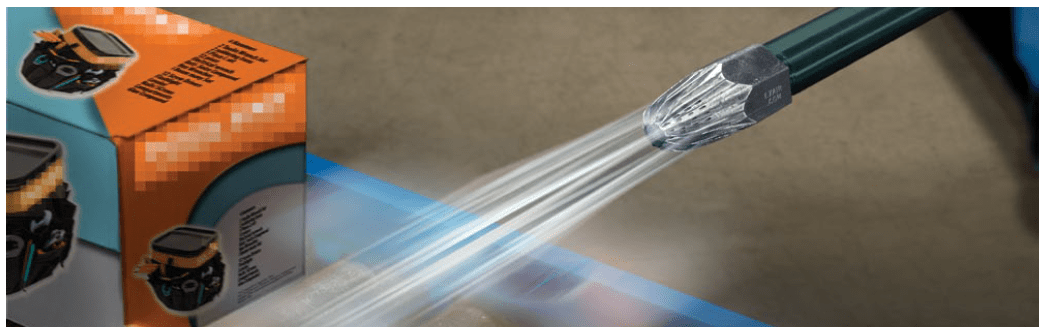
I recommended installing two Electronic Flow Control (EFC) units and replacing their existing nozzles and open pipe with the EXAIR model 1126 1″ Flat Super Air Nozzle outfitted with swivels to allow them to be positioned properly to reach under the bottle cap. Proper positioning, in many cases, increases the effectiveness of the nozzles and can get the job done with fewer nozzles installed. In this application I am confident we can get that bottle cap area blown off with only 2 nozzles.

By eliminating excessive nozzles and cycling compressed air on and off only as needed, the customer saves compressed air. I estimated it was enough compressed air to install a 24″ Deluxe Super Air Knife Kit to blow down on top of the gallon containers, which is the primary reason they asked me to visit in the first place. This will not only give them the 24″ Super Air Knife, but it will also include the crucial EFC and a filter separator to clean the compressed air and a pressure regulator to adjust the pressure down to the minimum necessary for success. All of these factors contribute to optimizing compressed air and using it effectively within anyone’s plant:

  • Eliminate open pipes and ineffective blow offs
  • Turn off compressed air whenever possible
  • Keep it clean to reduce wear and maintenance
  • Adjust the pressure to a minimum level for success

This is just one location in the entire facility where implementing the Electronic Flow Control and EXAIR engineered nozzles will help the customer to optimize their compressed air use.

If you would like to learn more or have questions on any of the EXAIR products mentioned in this blog, feel free to contact us.

Brian Farno
Application Engineer
BrianFarno@EXAIR.com
@EXAIR_BF

On the lighter side

Well, it’s almost everyone’s favorite time of the year, swimsuit season!!!. I said ALMOST everyone. Which means that crash diets and “lighter” fare choices are in full swing. (I know I need to be incorporating these myself).

Sticking with this theme, I thought I would write this week’s blog on our Light Duty Line Vac. These units provide an alternative solution for conveying smaller volumes of material over a short distance.

Available in eight common sizes, ¾” up to 6”, in aluminum construction, these units use less compressed air than our other Line Vac products. The Light Duty Line Vac also has no moving parts and requires no electricity to operate, making them virtually maintenance free!

Light Duty Line VacAir consumption is minimal, ranging from our smallest unit consuming 7.30 SCFM @ 80 PSI, up to our largest unit consuming 80.20 SCFM @ 80 PSI.  You can also control the conveying rate by regulating your compressed air supply pressure.

For even more control, you could add one of our Electronic Flow Control (EFC) which uses timing control and a photoelectric sensor to turn off your compressed air when there is no media/part present.

Image

To see our complete line of Air Operated Conveyors, visit our website www.EXAIR.com or if you need assistance with an application, please do not hesitate to contact an application engineer at 1-800-903-9247.


Justin Nicholl
Application Engineer
JustinNicholl@EXAIR.com
@EXAIR_JN

Pet Peeve: Lights On In An Empty Room

As the father of two sons, I spend a lot of time telling them to turn off the lights in their rooms when they leave them. I also spend a lot of time turning the lights off in their rooms after they’ve long left them. To their credit, though, they’re both pretty good about putting away their clean clothes, getting their dirty laundry to the hamper, clearing the dinner table, etc…they do give me a lot to be proud of, responsibility-wise, so flipping a light switch a couple times a day isn’t so bad, all things considered. As I wrote about a while back, the electric company gave me a bunch of CFL light bulbs, which I promptly installed throughout the house, so I’m really getting off light (pun intended.)
turnoff

Compressed air users don’t get so lucky, though…in fact, turning off compressed air flow when it’s not needed is among the most valuable of the “Best Practices for Compressed Air Systems,” as published by the fine folks at the Compressed Air Challenge. And this is where the compressed air users’ luck can change by using EXAIR’s EFC Electronic Flow Control.

The EFC is a system consisting of a programmable timer which opens and closes a solenoid valve, based on input from a photoelectric sensor. A typical installation might be on a conveyor belt, where gaps exist between parts that are being blown off by a compressed air device like an Air Knife, Air Nozzle, Air Amplifier, etc. The sensor would be mounted to “see” the parts when they’re in position for blow off…when one is there, it’ll open the solenoid valve. When the part has passed, it closes the valve.

If your application isn’t quite so “cut and dry,” the timer has eight modes of operation to choose from, and the time scale is adjustable down to a tenth of a second. For more details on this, Lee Evans made a fine video that explains it all.

If you have a blow off that doesn’t need to be continuous, then the EFC is just what you need. For selection assistance, contact an EXAIR Application Engineer – we’re eager to help!

Russ Bowman
Application Engineer
EXAIR Corporation
(513)671-3322 local
(800)923-9247 toll free
(513)671-3363 fax
Web: http://www.exair.com
Blog: http://blog.exair.com/
Twitter: twitter.com/exair_rb
Facebook: http://www.facebook.com/exair

A Few More Ways to Use the EFC

The most popular use for our Electronic Flow Control units is for an intermittent operation for blow off.  This would be jobs such as computer monitors that need the screen blown off as they are coming down a conveyor belt.  While this is ideal for the EFC there are other ways you can use this compressed air saving device.

One way would be for part ejection.  This would be a case where maybe some pieces are taller than others and so you want to blow off the tall parts into a bin.  Simply set the sensor at the height just above the height for the short product and then every piece that is above that height will trigger the sensor and blow it off the line.

Another use would be to tell when a hopper that is being filled by a Line Vac is empty or over filled.  You can adjust the sensor and the control module to sense that the hopper is empty and it will turn the compressed air on to the Line Vac to then feed the hopper.  Then set the timer module so it will run for the length of time it takes to fill the hopper.  The other way would be to place the sensor at the top of the hopper and have it sense when the pile of media has reached the full level.

As with many of the other EXAIR products the Electronic Flow Control offers a solution to more than just one application.

Brian Farno
Application Engineer
BrianFarno@EXAIR.com
@EXAIR_BF