
How To Calculate Your Return On Investment From Using Engineered Compressed Air Products

There’s an old saying that goes “If it isn’t broken, don’t fix it.” Best case, this means it may not be necessary to repair, refurbish, or replace something just because there’s a newer offering on the market. Worst case, it’s used to justify continued use of something when the aforementioned repair, refurbishment, or replacement will result in quantifiable benefits. THAT makes THIS quote all the more applicable:

“The most dangerous phrase in the English language is: We’ve always done it this way. It raises the question, ‘Are we doing this because we always have, or because it’s the right thing to do?’”
-Grace Hopper, Rear Admiral USN & computer pioneer

If you consider “not spending any more than you have to on compressed air” to be “the right thing to do”, then this blog’s for you. Read on, and we’ll calculate not only how much you might save by using engineered compressed air products in place of what you’re using now, but how soon that amount you save will equal how much you spent on those products…that’s called Return On Investment, or ROI. Let’s work through an example:

A popular air gun fitted with a cross-drilled nozzle for OSHA compliance uses 34 SCFM @80psig. These are commonly replaced by our Model 1210 Soft Grip Safety Air Guns fitted with our Super Air Nozzles, which consume only 14 SCFM @80psig. It’s not likely that the trigger on an Air Gun used for blowing, cleaning, drying, etc., will be pulled continuously, but we can assume that two hours of “trigger time” per day (for an eight-hour shift) is reasonable. Here’s how to calculate annual savings:

(34-14 SCFM) X 60 min/hr X 2 hrs/day X 5 days/wk X 50 wks/yr=600,000 Standard Cubic Feet saved

Model 1210 Soft Grip Safety Air is fitted with an EXAIR Super Air Nozzle. We can also supply it with a Rigid Extension and Chip Shield (right).

Now, we need to determine the cost of your compressed air. The calculation for that, per the U.S. Department of Energy, is as follows:

Cost ($) = {bhp X 0.746 X # of operating hours X $/kWh X % time X % full load bhp}/motor efficiency

Where:
bhp = motor full load horsepower
0.746 = conversion from hp to kW
% time = percentage of run time at this operating level
% full load bhp = brake horsepower as percentage of full load bhp at this operating level
Motor efficiency = motor efficiency at this operating level

For simplicity, you could also get a fairly accurate answer by applying an “industry standard” thumb rule which states that a typical industrial air compressor generates ~4 SCFM per HP. If you know your electricity cost ($/kWh), you can calculate the cost of compressed air generation as follows. To keep most of the digits to the left of the decimal point, it’s commonly calculated as $ per 1,000 Standard Cubic Feet:

$/kWh X 0.746 hp/kW ÷ 4 hp/SCFM ÷ 60 min/hr X 1,000 = $ per 1,000 SCF

For EXTRA simplicity, you can use ANOTHER thumb rule, also endorsed by the Department of Energy, which states that compressed air costs about $0.25 per 1,000 SCF. It uses the above formula, and a typical estimate for electricity cost of $0.08 per kWh which my buddy Brian Farno did the math and provided a detailed explanation on that one here. So:

600,000 SCF X $0.25/1,000 SCF = $150.00 saved by switching to the EXAIR Safety Air Gun

Given the cost (current 2023 List Price) of $115.00 for the Model 1210 Soft Grip Safety Air Gun, we can calculate Return On Investment as a function of time…how long it takes before you end up saving the amount you spent:

$115.00 saved ÷ $150.00 spent X 12 months in a year = 9.2 months

At EXAIR (if you hadn’t figured it out already), we LOVE to do the math, but if you don’t (no judgment), we’ve got calculators on our website for that. Just fill in a few blanks, and get your answer. If there’s anything I can help with, though, give me a call.

Russ Bowman, CCASS

Application Engineer
Visit us on the Web
Follow me on Twitter
Like us on Facebook

How EXAIR Uses Fluidics To Make Efficient, Quiet, and Safe Compressed Air Products

EXAIR Intelligent Compressed Air Products incorporate several distinct principles of fluidics into our engineered designs. To be clear, these principles aren’t exclusive to making quiet and efficient compressed air products. I personally have used them all for business and pleasure over the years. In the Navy, for example, the air ejectors that pulled vacuum on the main condensers where our turbines dumped their ‘used’ steam were basically great big Venturis – they restricted the diameter through which a fluid (steam, in this case) flowed, gradually increased that diameter, and doing so, changed the velocity so that a low pressure area (or vacuum) developed in the throat:

Graphic representation of the Venturi effect.

EXAIR E-Vac Vacuum Generators use the Venturi effect to draw vacuum of up to 27″Hg. They’re typically used with Vacuum Cups for pick-and-place material handling applications.

Here are a few examples of Mr. Venturi’s discovery, implemented in modern industry.

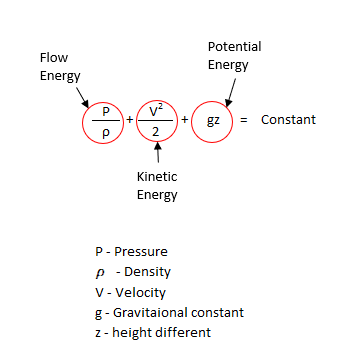
I first learned about the Bernoulli principle on a grade school field trip to the National Air Force Museum at Wright Patterson Air Force Base, about an hour from where I grew up. See, this Bernoulli guy discovered that when there is an increase in the speed of a fluid, a simultaneous decrease in fluid pressure occurs at the same time. That’s why airplane wings are shaped like they are – flat on the bottom and curved on top…when the air flowing that extra distance over the top speeds up to get to the back of the wing as fast as the air that’s simply flowing underneath the wing does, the decrease in pressure on top causes the wing (and the plane it’s attached to) rise in the air.

Bernoulli’s Equation: this is the math that proves it works.

The Bernoulli principle is incorporated in to the design & operation of EXAIR engineered Air Knives, Air Wipes, Air Amplifiers, and Air Nozzles.

The Coanda effect is the third fluidics principle that’s incorporated into the design & operation of many EXAIR engineered compressed air products. Its namesake, Henri Coanda, was an early 20th Century aeronautical engineer who discovered that if a jet of fluid exiting an orifice flows across a surface, it’ll tend to not only adhere to and follow that surface (even if it curves or bends), but also entrain fluid from the surrounding area.

EXAIR Intelligent Compressed Air Products such as (left to right) the Air Wipe, Super Air Knife, Super Air Nozzle, and Air Amplifier all use the Coanda effect to entrain enormous amounts of air from the surrounding environment.

There are a couple of easy – and interesting – experiments that demonstrate the Coanda effect, both of which I used when I was a Cub Scout leader and our Pack’s Webelos den was earning their Science Activity Pin:

Turn a faucet on and let the running water flow over the convex ‘bottom’ of a spoon. Everything we know about the laws of gravity say that when the water reaches the ‘bottom-most’ point on the spoon’s convex surface, it ought to fall straight down…but it doesn’t:

Another experiment that defies everything we think we know about gravity can be performed with a ball, and a source of air flow. Here’s a short video, showing how the air flow from an Air Amplifier ‘wraps’ around a ball and holds it in that jet of air:

The Webelos den did this with a leaf blower and a playground ball. Unlike a lot of things I’ve done, I DEFINITELY encourage you to try THAT at home.

For forty years now, EXAIR has been putting these principles of fluidics into practice by engineering & manufacturing the most efficient, quietest, and safest compressed air products on the market. If you’d like to find out how we can help you get the most out of our products – and your compressed air system – give me a call.

Russ Bowman, CCASS

Application Engineer
Visit us on the Web
Follow me on Twitter
Like us on Facebook

TurboBlast Safety Air Guns – Up To 23 Pounds Of Force At The Push Of A Button

I had the pleasure, recently, of talking with a customer at a paper good manufacturing facility who needed an air gun with a LOT of force for some applications, a little less for others, and was hoping to find one device that gave the operator control over it. They were using a piece of 1/2″ pipe on the end of a ball valve. The operators were trying (and mostly failing) to get precise control by throttling that valve. When they needed a LOT of force, it was no problem – just open the valve all the way. Unfortunately, though, ball valves aren’t known for being precision throttling devices, so most of the “little less” force jobs were getting too much force (and making a bigger mess) or not enough (leaving the existing mess) around the machinery.

After reviewing our Safety Air Guns catalog, they decided to try the Model 1927 TurboBlast Safety Air Gun. They liked:

  • Hard hitting power – the Model 1118 High Force Super Air Nozzle‘s flow (when supplied @80psig) generates 15 pounds of force at a distance of 12″ from the target.
  • Nozzle Guard – there was a great potential for the tip to get banged up from incidental contact with the machinery. The rugged Nozzle Guard protects not only the Air Nozzle, but the equipment as well, as the Zinc Aluminum Super Air Nozzle could have left scratches in some of the parts that were painted.
  • Adjustable Gate Valve – this provides the precise control their operators need to clean up the aforementioned mess, without creating a bigger one.
  • Pushbutton control – the low profile button trigger actuates with just a slight squeeze. Much more ergonomic than having to grasp the ball valve’s handle tight, especially when they needed it in a partially open position.
Features & benefits of the new TurboBlast Safety Air Gun

No matter what the scope of a blow off application is, EXAIR has a wide selection of Safety Air Guns to meet your needs. If you’d like to find out more, give me a call.

Russ Bowman, CCASS

Application Engineer
Visit us on the Web
Follow me on Twitter
Like us on Facebook
EXAIR Safety Air Guns Reduce Air Consumption & Sound Levels Without Sacrificing Performance

I recently had the pleasure of discussing Safety Air Gun performance with the Safety Director of a manufacturing facility who needed to address the high noise levels in their machine shop. They were using inexpensive thumb trigger blow offs:

The sound level generated by this air gun was 87dBA, when supplied with compressed air at 80psig. That’s just under the 90dBA maximum allowable noise exposure per OSHA Standard 1910.95(a) for 8 hour exposure.

It’s important to note that handheld blow off devices are RARELY operated continuously, but even in short bursts, excessively high noise levels like that (even if they’re technically within OSHA limits) aren’t a lot of fun to be around, and Safety Directors aren’t the kind of folks who are typically OK with operating right at a published limit. I know EXAIR’s Safety Director isn’t, and neither is this company’s.

After discussing the specifics of what they use these for, we determined that two specific EXAIR Safety Air Guns would meet their machinists’ needs at different machines: Model 1699-CS VariBlast Compact Safety Air Gun with our Mini Super Air Nozzle & Chip Shield, and Model 1809-PEEK-CS VariBlast Precision Safety Air Gun with our Pico Super Air Nozzle (PEEK thermoplastic for non-marring performance in case of incidental contact with the parts they’re blowing off) & Chip Shield.

The VariBlast Compact Safety Air Gun (left) has two ports to choose from – this one uses the one on the back of the handle. The VariBlast Precision Safety Air Guns (right) have a molded plastic grip for ergonomics. Both feature a variable flow trigger to give the operator total control of the flow & force generated from the efficient & quiet Super Air Nozzle.

The sound level of the Mini Super Air Nozzle on the Model 1699-CS is only 71dBA, and Pico Super Air Nozzle on the Model 1809-PEEK-CS is only 68dBA. Those sound levels are barely discernible in a typical machine shop during normal operation…and FAR less than OSHA’s limits, in any case.

In addition to the sound level reduction, the compressed air consumption was greatly reduced as well. Their device was tested in our Efficiency Lab, and uses 22.3 SCFM @80psig. The air consumption of the Model 1699-CS is only 10 SCFM @80psig, and Model 1809-PEEK-CS uses only 4.9 SCFM @80psig.

The additional benefit of the operators being able to control the flow & force by the variable flow trigger will almost certainly reduce ALL of those values as muscle memory ‘fine tunes’ the amount of pull they apply to the trigger. I think that qualifies for a win-win-win, any day.

If you use air guns in your facility, and they’re not EXAIR Safety Air Guns, you owe it to yourself – and your electric bill & your co-workers’ hearing – to check us out.

Russ Bowman, CCASS

Application Engineer
Visit us on the Web
Follow me on Twitter
Like us on Facebook