Daniel Bernoulli was born on February 8, 1700, in Groningen in the Netherlands. He is the son of Mathematician Johann Bernoulli, who was an early developer of Calculus. Daniel took an interest in mathematics when he was just 7 years old. Although his father tried to dissuade him from focusing on mathematics due to the limited financial gain, Johann did tutor his son in calculus and theories of kinetic energy.
Daniel continued to show promise, attending Basel University at the age of 13, where he studied logic and philosophy. By the time he was 15 years old, he had completed his bachelor’s degree, and earned his master’s degree a year later. At the age of 23, he moved to Venice, Italy to learn medicine, but he couldn’t get away from mathematics, becoming a professor of a university in Venice a year later.
In 1738, Bernoulli published the book Hydrodynamica, where he first explained what we know as Bernoulli’s Principle. This is of particular interest to us at EXAIR, as many of our products operate off of this principle. It states that an increase in the speed of a fluid occurs simultaneously with a decrease in pressure. This is derived from the conservation of energy, where an increase in kinetic energy (speed) requires a corresponding reduction in potential energy (pressure).
When compressed air exits the precise slotted nozzle of our Super Air Knife, this induces a low pressure area, which speeds up and draws in ambient air. This air entrainment (at a ratio of 40:1) is what makes our Super Air Knives so efficient. This same effect can be witnessed with our Super Air Amplifiers, Super Air Nozzles, Super Air Wipes, as well as many other products.
The high speed of the air exiting the (left to right) the Air Wipe, Super Air Knife, Super Air Nozzle, and Air Amplifier creates a low pressure (just like Daniel Bernoulli said) that causes entrainment of an enormous amount of air from the surrounding environment. This maximizes flow while minimizing consumption of your compressed air.
If you would like to discuss your application, and how the Bernoulli Principle may be beneficial, feel free to give us a call!
Probably the most common application for EXAIR’s line of Air Wipes is blowing off continuous runs of pipe, hose, tube, wire, etc. The 360° converging air flow sweeps the entire circumference evenly, for efficient & quiet blow off, cooling, or drying. The split ring design means the operator doesn’t have to “thread” the product through the Air Wipe:
Split ring design eliminates the need for product “threading” through the Air Wipe.
Because of their 360° converging air flow, they’re also incredibly well-suited to another application: blowing off the end – or tip (to make the pun in the title work) – of an applicator.
A manufacturer of automated paint systems for the automotive industry fits spray heads to the ends of robotic arms to coat vehicle bodies. They install Model 2439 9″ Standard Air Wipes for the robots to periodically dip the spray heads through to clean off excess paint so it doesn’t drip inadvertently onto the surfaces that they’re putting a nice, even coating onto.
A custom furniture builder used a robotic system to apply glue to wood parts prior to fitting them together. A small amount of glue remained on the tip of the applicator, which would harden and build up over time, eventually getting to the point where not enough glue was applied. They periodically removed & cleaned the tips, but sometimes not before improperly glued products made it through production. They installed Model 2400 1/2″ Super Air Wipes for the robots to dip the applicator tips through to blow off the glue residue. This eliminates glue buildup and defective furniture parts.
A machine builder’s design incorporated robotic arms to dip two files in oil before using them to deburr parts, and wanted to stop oil from dripping off the file in between the oil dip and point of use. They installed two Model 2431 1″ Standard Air Wipes (one for each file) and set pressure regulators to remove excess oil while leaving enough to properly lubricate the file, and made the operation drip free.
A shop that repairs & tests diesel fuel injectors passes them through a Model 2432 2″ Standard Air Wipe by hand to blow off solvent after removing them from a cleaning tank, prior to reassembly & testing.
If you need to blow off parts from all sides, look no further than EXAIR Air Wipes. They come in sizes from 3/8″ to 11″, in stock. If you’d like to discuss your application or product selection, give me a call.
Russ Bowman, CCASS
Application Engineer Visit us on the Web Follow me on Twitter Like us on Facebook
A manufacturer of special pipes sent me a video of their operation. After the pipes were extruded, they would run them through a wash system to cool and harden them. After the wash system, they needed to remove the excess water from a 3” (76mm) diameter tube at a speed of 50 feet per minute (15 meters per minute). They were using a blower system to blow the water off the pipe with a series of blower air knives. The company was looking to increase the speed of the lines to be more productive and profitable. As they did some trial runs, they were only getting around 75% dryness. They needed a better way to get the pipes dry before ink printing.
This company makes plastic pipes ranging from 2” (51mm) to 8” (203mm) in diameter. When they searched for pipe and tube blow-off devices, they came across EXAIR and our Air Wipe product line. The design of the EXAIR Standard Air Wipe blows compressed air at a 30-degree angle toward the center in a 360-degree air pattern. It uses a Coanda profile to maximize the entrainment of ambient air into the compressed air stream to produce a strong force. As a non-contact wiping device, the Standard Air Wipe is very efficient and powerful. EXAIR also offers the Super Air Wipes for more stringent applications. You can read more about them here: What’s So Super About EXAIR’s Super Air Wipe?
Standard Air Wipe
For this application, I recommended the model 2484 4” Standard Air Wipe Kit. This kit includes our Standard Air Wipe, a Filter Separator, a Regulator, and a Shim Set. With a ½” or 13mm clearance, it gave ample room to allow the 3” (76mm) pipe to travel through without touching and to allow for ambient air to be entrained. The Filter Separator will remove bulk liquids and debris from the compressed air to keep the unit performing optimally and to keep the pipe from getting dirty. The Pressure Regulator is used to control the amount of force. This helps to not overuse the amount of compressed air required for the cleaning. With a Pressure Regulator, you can make fine adjustments to get the proper amount of force on your target, while the shims in the Shim Set will give you coarse adjustments. With the Pressure Regulator and Shim Set together, you can “dial in” the correct amount of force required for the different speeds. The Standard Air Wipe Kits will give you the most versatility in your system to optimize the 360-degree blow-off.
As the customer removed the original blower unit and attached the Standard Air Wipe to their compressed air system, they noticed some great things. The speed of production was increased by about 10%, which matched the maximum speed of the machine. The water removal from the surface was nearly 100%. They also noticed that the Standard Air Wipe was much quieter – near 82 dBA at 80 PSIG (5.5 bar). The nearby operators were very happy with this choice, as the blower-type system was very loud. And, with no moving parts, the Air Wipe did not need the same maintenance requirements as the blower system did, and it used a much smaller footprint. Also, we use a split design to mount the Standard Air Wipe around the outside of the pipe without cutting into the extruded lengths.
Here are some comparisons with the EXAIR Standard Air Wipes to a blower-type system.
Cost:
Blower System: Blower-type air knives are expensive to set up. They require a blower, knives, and large (3″ – 4″ diameter) ducting. To have any flexibility, a control panel will be needed with a VFD to control the speed of the blower.
Standard Air Wipe: It is a fraction of the cost. With their system, we were roughly 1/10 the cost, even with the kit. No capital expense report would be needed.
Installation:
Blower System: The customer stated that it took them a week to install the entire system before they were able to operate. They had to run electrical wires, controls, and ducting, and they even had to change their system design to accommodate the blower size.
Standard Air Wipe: They mounted the filter and the regulator on the conveyor and ran tubing to the Standard Air Wipe. Even with a fabricator making a bracket to fit the Standard Air Wipe around the pipe, they had the system up and running in less than two hours.
Size:
Blower System: The footprint of the blower is large, and it takes up floor space. The 3” ducting had to be run to an oversized air knife. With the congestion in the area, it was difficult to optimize the position and the blowing angle to adequately dry the pipes.
Standard Air Wipe: With its compact design, the Super Air Knife packs a large force in a small package. It has a small footprint that fits around the pipe. It only required a ¼” NPT compressed air line to supply the compressed air. It opened up the floor space as well as the general area.
Maintenance:
Blower System: The blower filter had to be changed regularly, and the system had to be checked for preventative maintenance. Being that the blower motor is a mechanical device, the bearings will wear, and the motor will fail over time. These items need to be checked quarterly as a PM, which increases the cost of running the system.
Standard Air Wipe: No moving parts to wear out. The only maintenance would be to change the filter once a year.
Versatility:
Blower System: They did have a VFD to control the blowing force. But it was still very limited. With the increase in pipe speed, it was beyond the maximum capacity of the blower.
Standard Air Wipe: With a regulator and the shim set, the blowing force can be controlled easily, from a breeze to a blast. With their application, the customer only required 40 psig with a standard 0.002” shim to clean and dry the pipes. They had the option to adjust the regulator or change the shim to get the appropriate amount of blowing force with the different line speeds.
Quiet:
Blower System: With the blower and turbulent air flow, the units are very loud. It had a sound level near 93 dBA, and with the operators working around the system, they needed PPE for hearing.
Standard Air Wipe: These units are very quiet. As mentioned above, the decibel level is only 82 dBA at 80 PSIG (5.5 bar). At 40 PSIG (2.8 bar), the sound level is much lower. This was very nice for the operators to work around as it wasn’t a constant noise nuisance, and it was below the OSHA limit for PPE.
With the creation of the EXAIR Standard Air Wipes, uniform cleaning, cooling, and blowing around the outside of parts is a simple task. You don’t have to worry about too many nozzles to target the circumference or fabricated blow-off air knives that will waste time and money. At EXAIR, we offer a 30-day unconditional guarantee for U.S. and Canadian customers. This customer used the 30-day trial to try the Standard Air Wipe. After the testing, they purchased the model 2491 11” Standard Air Wipe Kit for their largest pipe. You can order them from our website at http://www.EXAIR.com or call us at 800-903-9247. If you need help selecting the proper size for your application, you can contact an Application Engineer at EXAIR for help.
John Ball Application Engineer Email: johnball@exair.com Twitter: @EXAIR_jb
EXAIR Intelligent Compressed Air Products incorporate several distinct principles of fluidics into our engineered designs. To be clear, these principles aren’t exclusive to making quiet and efficient compressed air products. I personally have used them all for business and pleasure over the years. In the Navy, for example, the air ejectors that pulled vacuum on the main condensers where our turbines dumped their ‘used’ steam were basically great big Venturis – they restricted the diameter through which a fluid (steam, in this case) flowed, gradually increased that diameter, and doing so, changed the velocity so that a low pressure area (or vacuum) developed in the throat:
Here are a few examples of Mr. Venturi’s discovery, implemented in modern industry.
I first learned about the Bernoulli principle on a grade school field trip to the National Air Force Museum at Wright Patterson Air Force Base, about an hour from where I grew up. See, this Bernoulli guy discovered that when there is an increase in the speed of a fluid, a simultaneous decrease in fluid pressure occurs at the same time. That’s why airplane wings are shaped like they are – flat on the bottom and curved on top…when the air flowing that extra distance over the top speeds up to get to the back of the wing as fast as the air that’s simply flowing underneath the wing does, the decrease in pressure on top causes the wing (and the plane it’s attached to) rise in the air.
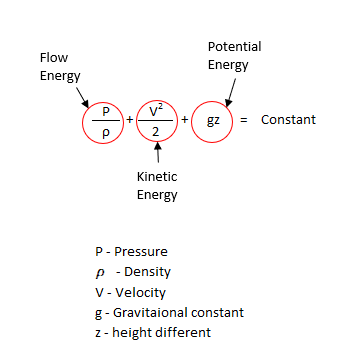
Bernoulli’s Equation: this is the math that proves it works.
The Coanda effect is the third fluidics principle that’s incorporated into the design & operation of many EXAIR engineered compressed air products. Its namesake, Henri Coanda, was an early 20th Century aeronautical engineer who discovered that if a jet of fluid exiting an orifice flows across a surface, it’ll tend to not only adhere to and follow that surface (even if it curves or bends), but also entrain fluid from the surrounding area.
EXAIR Intelligent Compressed Air Products such as (left to right) the Air Wipe, Super Air Knife, Super Air Nozzle, and Air Amplifier all use the Coanda effect to entrain enormous amounts of air from the surrounding environment.
There are a couple of easy – and interesting – experiments that demonstrate the Coanda effect, both of which I used when I was a Cub Scout leader and our Pack’s Webelos den was earning their Science Activity Pin:
Turn a faucet on and let the running water flow over the convex ‘bottom’ of a spoon. Everything we know about the laws of gravity say that when the water reaches the ‘bottom-most’ point on the spoon’s convex surface, it ought to fall straight down…but it doesn’t:
Another experiment that defies everything we think we know about gravity can be performed with a ball, and a source of air flow. Here’s a short video, showing how the air flow from an Air Amplifier ‘wraps’ around a ball and holds it in that jet of air:
The Webelos den did this with a leaf blower and a playground ball. Unlike a lot of things I’ve done, I DEFINITELY encourage you to try THAT at home.
For forty years now, EXAIR has been putting these principles of fluidics into practice by engineering & manufacturing the most efficient, quietest, and safest compressed air products on the market. If you’d like to find out how we can help you get the most out of our products – and your compressed air system – give me a call.
Russ Bowman, CCASS
Application Engineer Visit us on the Web Follow me on Twitter Like us on Facebook