
Which Air Nozzle Is Right For Me?

Well, the obvious answer is, of course, an engineered air nozzle…you’re likely aware of this, or you wouldn’t be reading posts on the EXAIR Corporation blog.  We have no issue with narrowing that down a bit, and saying that the answer is an EXAIR air nozzle.  I bet you knew that was coming as well.  So let’s assume that, because of the cost of compressed air, the potential hazards of its unregulated discharge, and the flat-out racket it can make (unless you do something about it,) you’re looking for something efficient, safe, and quiet.

Now that we’re on the same page, let’s unpack that question.  The nature of the application will let us know the airflow pattern & characteristics (mainly flow & force) that we need.

For example, if you need just a pinpoint of airflow, our Atto Super Air Nozzle blows a 1/2″ diameter pattern at a distance of 3″.  Get a little closer than that, and it’s as tight as you want it to be.  Now, it’s only generating a force of 2oz (at 12″ away) but keep in mind that’s all concentrated in a small fraction of an inch diameter.  Which is plenty for most applications that need that precise of an airflow.

Atto Super Air Nozzle

If you DO need a little more flow & force, our Pico and Nano Super Air Nozzles offer incremental increases in performance.  The pattern starts to widen out, but that’s a function of the increased flow expanding in to atmospheric pressure…it has to go somewhere, you know.  But, again, the closer you get, the more focused the flow is to the centerline of the nozzle.

On the other end of the spectrum are EXAIR’s High Force Air Nozzles.  These are particularly useful for stubborn blowoff applications – a foundry blowing slag off hot strip as it cools, for example.  Our largest of these, a 1-1/4 NPT model, generates 23 lbs of force…that’s over 25 times the power of our standard Super Air Nozzle.


With 23 lbs of hard hitting force, this 1-1/4 NPT Super Air Nozzle is perfect for the most extreme blow off and cleaning jobs.

Speaking of the standard Super Air Nozzle, it’s the most popular answer to the Big Question.  It’s suitable for a wide range of blowoff, drying, and cooling applications, like the kinds of jobs an awful lot of folks use open end blowoff devices on.  Open ended tubes blow out a great amount of air, but they’re wasteful and noisy, and OSHA says you can’t use them unless you regulate the pressure to 30psig…where they’re not even going to be all that effective.

Choose from (top left to bottom right) 316SS, Zinc Aluminum, or PEEK Thermoplastic…whatever you need to stand up to the rigors of your environment.

If you’ve got a 1/4″ copper tube, for example, it’ll use 33 SCFM when supplied with compressed air at 80psig.  It’ll for sure get the job done (albeit expensively, when you think of all that compressed air consumption,) but it’ll be loud (likely well over 100 dBA) and again, OSHA says you can’t use it at that pressure.  So, you can dial it down to 30psig, where it’ll be marginally effective, but it’s still going to use more air than the Model 1100 1/4 NPT Super Air Nozzle does at 80psig supply pressure.  The hard hitting force of the Model 1100, under those conditions, will make all the difference in the world.  As will its sound level of only 74 dBA.  Not to mention, it’s fully compliant with OSHA 1910.242(b).  Oh…and you can even install it directly on the end of your existing tube with a simple compression fitting.

One of our customers installed Model 1100 Super Air Nozzles on all their lathe blowoff copper tubes, and saved almost $900 a year in compressed air costs.

We’ve also got engineered Air Nozzles smaller than the 1100 (all the way down to the aforementioned Atto Super Air Nozzle) and a good selection of larger ones, including Cluster Air Nozzles that hold tighter airflow patterns than similar performing single Super Air Nozzles.  They’re available in materials ranging from Zinc-Aluminum alloy, bare aluminum, brass, 303SS, 316SS, or PEEK thermoplastic polymer to meet the requirements of most any area of installation, no matter how typical or aggressive.

If you have an loud, wasteful, and likely unsafe blowoff, you owe it to yourself and everyone else who has to put up with it to consider a better solution.  Call me; let’s talk.

Russ Bowman
Application Engineer
EXAIR Corporation
Visit us on the Web
Follow me on Twitter
Like us on Facebook


People of Interest: Daniel Bernoulli

Daniel Bernoulli

Whenever there is a discussion about fluid dynamics, Bernoulli’s equation generally comes up. This equation is unique as it relates flow energy with kinetic energy and potential energy. The formula was mainly linked to non-compressible fluids, but under certain conditions, it can be significant for gas flows as well. My colleague, Tyler Daniel, wrote a blog about the life of Daniel Bernoulli (you can read it HERE). I would like to discuss how he developed the Bernoulli’s equation and how EXAIR uses it to maximize efficiency within your compressed air system.

In 1723, at the age of 23, Daniel moved to Venice, Italy to learn medicine. But, in his heart, he was devoted to mathematics. He started to do some experiments with fluid mechanics where he would measure water flow out of a tank. In his trials, he noticed that when the height of the water in the tank was higher, the water would flow out faster. This relationship between pressure as compared to flow and velocity came to be known as Bernoulli’s principle. “In fluid dynamics, Bernoulli’s principle states that an increase in the speed of fluid occurs simultaneously with a decrease in static pressure or a decrease in the fluids potential energy”1. Thus, the beginning of Bernoulli’s equation.

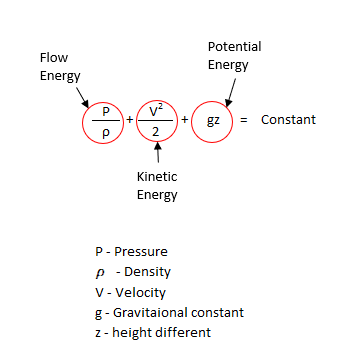
Bernoulli realized that the sum of kinetic energy, potential energy, and flow energy is a constant during steady flow. He wrote the equation like this:

Equation 1:

Bernoulli’s Equation

Not to get too technical, but you can see the relationship between the velocity squared and the pressure from the equation above. Being that this relationship is a constant along the streamline; when the velocity increases; the pressure has to come down. An example of this is an airplane wing. When the air velocity increases over the top of the wing, the pressure becomes less. Thus, lift is created and the airplane flies.

With equations, there may be limitations. For Bernoulli’s equation, we have to keep in mind that it was initially developed for liquids. And in fluid dynamics, gas like air is also considered to be a fluid. So, if compressed air is within these guidelines, we can relate to the Bernoulli’s principle.

  1. Steady Flow: Since the values are measured along a streamline, we have to make sure that the flow is steady. Reynold’s number is a value to decide laminar and turbulent flow. Laminar flows give smooth velocity lines to make measurements.
  2. Negligible viscous effects: As fluid moves through tubes and pipes, the walls will have friction or a resistance to flow. The surface finish has to be smooth enough; so that, the viscous effects is very small.
  3. No Shafts or blades: Things like fan blades, pumps, and turbines will add energy to the fluid. This will cause turbulent flows and disruptions along the velocity streamline. In order to measure energy points for Bernoulli’s equation, it has to be distant from the machine.
  4. Compressible Flows: With non-compressible fluids, the density is constant. With compressed air, the density changes with pressure and temperature. But, as long as the velocity is below Mach 0.3, the density difference is relatively low and can be used.
  5. Heat Transfer: The ideal gas law shows that temperature will affect the gas density. Since the temperature is measured in absolute conditions, a significant temperature change in heat or cold will be needed to affect the density.
  6. Flow along a streamline: Things like rotational flows or vortices as seen inside Vortex Tubes create an issue in finding an area of measurement within a particle stream of fluid.

Super Air Knife has 40:1 Amplification Ratio

Since we know the criteria to apply Bernoulli’s equation with compressed air, let’s look at an EXAIR Super Air Knife. Blowing compressed air to cool, clean, and dry, EXAIR can do it very efficiently as we use the Bernoulli’s principle to entrain the surrounding air. Following the guidelines above, the Super Air Knife has laminar flow, no viscous effects, no blades or shafts, velocities below Mach 0.3, and linear flow streams. Remember from the equation above, as the velocity increases, the pressure has to decrease. Since high-velocity air exits the opening of a Super Air Knife, a low-pressure area will be created at the exit. We engineer the Super Air Knife to maximize this phenomenon to give an amplification ratio of 40:1. So, for every 1 part of compressed air, the Super Air Knife will bring into the air streamline 40 parts of ambient “free” air. This makes the Super Air Knife one of the most efficient blowing devices on the market. What does that mean for you? It will save you much money by using less compressed air in your pneumatic application.

We use this same principle for other products like the Air Amplifiers, Air Nozzles, and Gen4 Static Eliminators. Daniel Bernoulli was able to find a relationship between velocities and pressures, and EXAIR was able to utilize this to create efficient, safe, and effective compressed air products. To find out how you can use this advantage to save compressed air in your processes, you can contact an Application Engineer at EXAIR. We will be happy to help you.

John Ball
Application Engineer
Email: johnball@exair.com
Twitter: @EXAIR_jb

  1. Wikipedia https://en.wikipedia.org/wiki/Bernoulli%27s_principle

Swivel Fittings: Adjusting Their Way Into Your Application

Ever had that spot that you needed to blow off but no matter how hard you tried you couldn’t reach the spot with piping? Well here at EXAIR we’ve got a solution for you; Introducing the swivel fitting! When blowing off various parts it is better to have an angled sweep of air rather than blowing directly across or directly down onto the part. EXAIR’s Swivel fittings provide a movement of 25 degrees from the center, meaning a total of 50 degrees.

EXAIR’s Swivel Fittings Adjusted
Regardless of size of the air nozzle we can provide a swivel fitting to fit all of our nozzles starting at an M4 Thread up to a 1” NPT. The M4 (4mm), M5 (5mm), and M6 (6mm) swivel fittings come with a Female NPT to screw the nozzle into and a Male NPT to attach to the swivel fitting to the pipe. For our 1/8” Fitting up to the 1” Fittings a male NPT is used to connect the Nozzle and a female NPT is used to connect to the pipe. The swivel fittings can easily be adjusted by either loosening or tightening the center hex nut.
EXAIR’s Family of Swivel Fittings
If the swivel fitting doesn’t give you the adjustment that you need, they can be coupled with our Stay Set Hoses to give extra adjustment and positioning. Our stay set hoses come in lengths of 6” all the way up to 36” and provide easy positioning for your application. Of course, these hoses can also be used without a swivel fitting. 
EXAIR’s Family of Stay Set Hoses
Swivel fittings are not used with just air nozzles, in many cases swivel fittings have been used with our smaller Air Amplifiers and our 3” Air Knifes.

For more information on EXAIR’s Swivel Fittings, Stay Set Hoses, or any EXAIR‘s Intelligent Compressed Air® Product lines, feel free to contact EXAIR and myself or any of our Application Engineers can help you determine the best solution.

Cody Biehle
Application Engineer
EXAIR Corporation
Visit us on the Web
Follow me on Twitter
Like us on Facebook
Free Money! Flat Super Air Nozzles Qualify for Energy Incentive

The patented design of EXAIR’s 1” and 2” Flat Super Air Nozzles makes them a highly efficient option when seeking a powerful, flat airflow. A precise air gap across the width of the nozzle provides a forceful stream of high velocity, laminar airflow without consuming high amounts of compressed air and also resulting in a greatly reduced sound level compared to some of the alternative flat nozzles available in the market.

Flat SAN not dumb picture
EXAIR’s Flat Super Air Nozzles have been blowing away the competition since 2003.

Did you know that upgrading to an efficient engineered air nozzle, such as the 1” or 2” Flat Super Air Nozzle, can make you eligible for an incentive from your energy provider? Similar to other energy-saving programs for upgrading to LED light bulbs or high-efficiency HVAC systems, these are made available to you as an incentive to start using more energy efficient products.

The energy costs associated with the generation of compressed air, often referred to in industry as a 4th utility, can make it expensive. These programs are offered to encourage you to use engineered products that are more energy efficient due to the reduction in compressed air consumption. Essentially, they’re offering you free money to implement a solution that will also save you money. It almost sounds too good to be true!! But these products, after implementation and receiving the incentive, will continue to save you money year after year.

The US Department of Energy, in conjunction with the NC Clean Energy Technology Center, provides a website that allows you to search the various programs available to you in your state. The DSIRE® website allows you to select your state, then select your energy provider to determine what programs are offered.

In Southwest Ohio, Duke Energy provides an incentive that offers $40 USD each per engineered air nozzle that is installed. When replacing open pipe or tube, these nozzles generally pay for themselves relatively quickly. But, when combined with a $40 USD rebate, that return on investment happens even quicker!!!

Don’t leave free money on the table. If you’re using open pipe or tube, or inefficient plastic flat nozzles, replace them with an engineered air nozzle from EXAIR. If you need help determining what rebate programs are available to you in your area, we’re also here to help. Contact an EXAIR Application Engineer today!

Tyler Daniel
Application Engineer
E-mail: TylerDaniel@EXAIR.com
Twitter: @EXAIR_TD