Air Knives & What You Don’t Normally See

In the day-to-day life of an Application Engineer here at EXAIR, you get to speak about every single one of our engineered solutions, and sometimes you find yourself getting into discussions about items we don’t make and even some new ways to use products that we haven’t showcased. The run-of-the-mill applications for Super Air Knives are cleaning, cooling, or drying materials off, whether it be stationary and the knife moves or if the product is moving and proceeding through the sheet of air produced by the Super Air Knife. No matter which of these applications, the one thing in common is that they are all supplying the Super Air Knife with compressed air. Okay, some use compressed nitrogen, and they are few and far between. There is another motive material that can be used that isn’t a gas and that doesn’t get discussed too much; water!

Just last week, I was speaking with a customer who was struggling with a point of their application where they needed a waterfall of liquid and didn’t want to use liquid atomizing spray nozzles because they were required to have a continuous “sheet” of liquid in order to have optimal performance. They knew the Super Air Knives worked great on their drying section, so they called and asked how they do with water?

Well, the answer is they do pretty well considering they were designed for compressed air, which is compressed and expands rapidly to atmospheric conditions and helps with our performance, while water cannot be compressed, only pressurized. The good news is we do have some data and pictures from tests on something like this. So I pulled out the information I had and shared it with the customer.

As you can see, increasing the gap a little bit and keeping a good supply lends to a nice stream at lower operating pressures, not even full city line water pressure. While we tested numerous gaps and inlet pressures, some of the best flows were from 17 psig inlet pressure and with a .004″ and up to a .012″ gap. The customer in this case was happy enough that they decided to get a knife and shim sets in to test under our 30-day guarantee, and it turns out they were getting the performance they needed with the .004″ thick gap and about 15 psig inlet pressure.

While the point of this was to showcase how well a product works with something other than compressed air that it wasn’t designed around, I hope to also emphasize that we truly have tested a vast number of variables with most of our products. If we don’t have test data on what you are thinking, as long as it is safe, and we have the ability, we will conduct a test. If we think the best thing to do is for you to get it in and test it, then we will back up our stock product offering with a 30-day guarantee. If we know it isn’t going to be a good fit, we will also tell you that.

If you want to discuss anything revolving around the point of use using compressed air or pressurized liquid being used in a process within your facility, please contact an Application Engineer today!

Brian Farno, MBA – CCASS Application Engineer

BrianFarno@EXAIR.com
@EXAIR_BF

Laminar Curtain of Air For Cleaning, Drying, Cooling, and Blowoff: EXAIR’s Super Air Knife

When a wide, even, laminar flow is necessary, there isn’t a better option available on the market than EXAIR’s Super Air Knife. We’ve been manufacturing Air Knives for 35 years now, with the Super Air Knife making its first appearance back in 1997. Since then, the Super Air Knife has undergone a few enhancements over the years as we’re constantly trying to not only introduce new products but also improve on the ones we have. We’ve added new materials, longer single piece knives, as well as additional accessories. But, by and large, the basic design has remained the same. As the saying goes “If it ain’t broke, don’t fix it!”.

What sets EXAIR’s Super Air Knife above the competition is the ability to maintain a consistent laminar flow across the full length of the knife, particularly when compared against blower-operated knives or even fans. A fan “slaps” the air, resulting in a turbulent airflow where the airflow particles are irregular and will interfere with each other. A laminar airflow, by contrast, will maintain smooth paths that will never interfere with one another.

The effectiveness of a laminar airflow vs turbulent airflow is particularly evident in the case of a cooling application. The chart below shows the time to cool computers to ambient temperatures for an automotive electronics manufacturer. They used a total of (32) 6” axial fans, (16) across the top and (16) across the bottom as the computers traveled along a conveyor. The computers needed to be cooled down before they could begin the testing process. By replacing the fans with just (3) Model 110012 Super Air Knives at a pressure of just 40 psig, the fans were cooled from 194 °F down to 81°F in just 90 seconds. The fans, even after 300 seconds, still couldn’t remove enough heat to allow the customer to test them.

Utilizing a laminar airflow is also critical when the airflow is being used to carry static eliminating ions further to the surface. Static charges can be both positive or negative. In order to eliminate them, we need to deliver an ion of the opposite charge to neutralize it. Since opposite charges attract, having a product that produces a laminar airflow to carry the ions makes the static reduction dramatically more effective. As you can see from the graphic above showing a turbulent airflow pattern vs a laminar one, a turbulent airflow is going to cause these ions to come into contact with one another. This neutralizes them before they’re even delivered to the surface needing to be treated. With a product such as the Super Ion Air Knife, we’re using a laminar airflow pattern to deliver the positive and negative ions. Since the flow is laminar, the total quantity of ions that we’re able to deliver to the surface of the material remains greater. This allows the charge to be neutralized more quickly, rather than having to sit and “dwell” under the ionized airflow.

With lengths from 3” to 108” and (4) four different materials all available from stock, EXAIR has the right Super Air Knife for your application. In addition to shipping from stock, it’ll also come with our unconditional 30-day guarantee. Test one out for yourself to see just how effective the Super Air Knife is in a wide variety of cooling, cleaning, or drying applications.

EXAIR Super Air Knives are the most efficient compressed air knife on the market, and for a limited time, you will receive a FREE Safety Air Gun when you purchase any EXAIR Super Air Knife! Learn more over on our site.

Tyler Daniel, CCASS

Application Engineer

E-mail: TylerDaniel@exair.com

Twitter: @EXAIR_TD

How EXAIR Uses Fluidics To Make Efficient, Quiet, and Safe Compressed Air Products

EXAIR Intelligent Compressed Air Products incorporate several distinct principles of fluidics into our engineered designs. To be clear, these principles aren’t exclusive to making quiet and efficient compressed air products. I personally have used them all for business and pleasure over the years. In the Navy, for example, the air ejectors that pulled vacuum on the main condensers where our turbines dumped their ‘used’ steam were basically great big Venturis – they restricted the diameter through which a fluid (steam, in this case) flowed, gradually increased that diameter, and doing so, changed the velocity so that a low pressure area (or vacuum) developed in the throat:

Graphic representation of the Venturi effect.

EXAIR E-Vac Vacuum Generators use the Venturi effect to draw vacuum of up to 27″Hg. They’re typically used with Vacuum Cups for pick-and-place material handling applications.

Here are a few examples of Mr. Venturi’s discovery, implemented in modern industry.

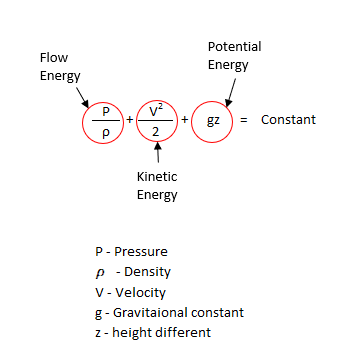
I first learned about the Bernoulli principle on a grade school field trip to the National Air Force Museum at Wright Patterson Air Force Base, about an hour from where I grew up. See, this Bernoulli guy discovered that when there is an increase in the speed of a fluid, a simultaneous decrease in fluid pressure occurs at the same time. That’s why airplane wings are shaped like they are – flat on the bottom and curved on top…when the air flowing that extra distance over the top speeds up to get to the back of the wing as fast as the air that’s simply flowing underneath the wing does, the decrease in pressure on top causes the wing (and the plane it’s attached to) rise in the air.

Bernoulli’s Equation: this is the math that proves it works.

The Bernoulli principle is incorporated in to the design & operation of EXAIR engineered Air Knives, Air Wipes, Air Amplifiers, and Air Nozzles.

The Coanda effect is the third fluidics principle that’s incorporated into the design & operation of many EXAIR engineered compressed air products. Its namesake, Henri Coanda, was an early 20th Century aeronautical engineer who discovered that if a jet of fluid exiting an orifice flows across a surface, it’ll tend to not only adhere to and follow that surface (even if it curves or bends), but also entrain fluid from the surrounding area.

EXAIR Intelligent Compressed Air Products such as (left to right) the Air Wipe, Super Air Knife, Super Air Nozzle, and Air Amplifier all use the Coanda effect to entrain enormous amounts of air from the surrounding environment.

There are a couple of easy – and interesting – experiments that demonstrate the Coanda effect, both of which I used when I was a Cub Scout leader and our Pack’s Webelos den was earning their Science Activity Pin:

Turn a faucet on and let the running water flow over the convex ‘bottom’ of a spoon. Everything we know about the laws of gravity say that when the water reaches the ‘bottom-most’ point on the spoon’s convex surface, it ought to fall straight down…but it doesn’t:

Another experiment that defies everything we think we know about gravity can be performed with a ball, and a source of air flow. Here’s a short video, showing how the air flow from an Air Amplifier ‘wraps’ around a ball and holds it in that jet of air:

The Webelos den did this with a leaf blower and a playground ball. Unlike a lot of things I’ve done, I DEFINITELY encourage you to try THAT at home.

For forty years now, EXAIR has been putting these principles of fluidics into practice by engineering & manufacturing the most efficient, quietest, and safest compressed air products on the market. If you’d like to find out how we can help you get the most out of our products – and your compressed air system – give me a call.

Russ Bowman, CCASS

Application Engineer
Visit us on the Web
Follow me on Twitter
Like us on Facebook

Create a Custom Blowoff Solution With EXAIR’s Industry-Leading Super Air Knives

EXAIR’s Super Air Knife utilizes a source of compressed air to create a laminar sheet of high velocity air. This supplied compressed air mixes with ambient air that is entrained into the primary airstream. The Super Air Knife entrains ambient air at a rate of 40:1, making it VERY effective in a variety of drying, cleaning, and cooling applications. Available in lengths ranging from 3”-108” and in a variety of different materials of construction, there’s a Super Air Knife available for just about any application. Any time you have product moving along a conveyor that needs to be cleaned, dried, or cooled off, a Super Air Knife is the ideal fit.

The Super Air Knife is available in aluminum, Type 303 & Type 316 stainless steel, as well as in PVDF with Hastelloy bolts for extremely corrosive applications.  While there are numerous options available off the shelf ready to ship same day, not all applications can be served by a stock option. Since EXAIR handles all the manufacturing of these products in our facility in Cincinnati, Ohio, we have a great deal of control over the manufacturing process. If your application cannot accept something right off the shelf, we’re constantly producing special customized knives to fit most requirements.

Our knives can be manufactured in a special length if a stock length won’t fit in your application. We’ll use the same design and size profile and can build it to the precise length you require in order to fit perfectly onto your machine. If the dimensional profile of an existing knife isn’t suitable, we can change that too! The Super Air Knife shown below utilizes a very thin design and has been completely modified to achieve the smallest overall profile possible.

All Super Air Knives come stock with ¼ NPT air inlets and ¼-20 tapped holes along the bottom that can be used for mounting. Unfortunately, that isn’t always going to work for every application, so we also manufacture specials with custom air inlets as well as additional mounting holes to fit right onto any custom bracket. The photo below shows a modified stainless steel Super Air Knife with additional mounting holes machined onto either end.

We don’t just offer them in different shapes and sizes as a special, but we’ve also manufactured stock length knives out of entirely different materials. Shown below are two knives of different materials that aren’t already on the shelf. On the left-hand side is a knife manufactured from PVDF and on the right a glass filled PEEK material with brass hardware and a PTFE shim. In this application, the customer was noticing ground interference due to the aluminum knife construction. They specified this particular material, and we were able to machine a knife completely customized for this application.

Every year a new request comes across that is something we haven’t done before. Just because you don’t see it in the catalog doesn’t mean it isn’t possible when you deal with EXAIR. We’re here to make sure you get the most out of our products, and sometimes that isn’t possible right off the shelf. Contact an Application Engineer today if you’d like to discuss your application and begin the process of identifying your next custom solution!

Tyler Daniel, CCASS

Application Engineer

E-mail: TylerDaniel@EXAIR.com

Twitter: @EXAIR_TD