Estimating the Cost of Compressed Air Systems Leaks

Leaks in a compressed air system can waste thousands of dollars of electricity per year. In fact, in many plants, the leakage can account for up to 30% of the total operational cost of the compressor. Some of the most common areas where you might find a leak would be at connection joints like valves, unions, couplings, fittings, etc. This not only wastes energy but it can also cause the compressed air system to lose pressure which reduces the end use product’s performance, like an air operated actuator being unable to close a valve, for instance.

One way to estimate how much leakage a system has is to turn off all of the point-of-use devices / pneumatic tools, then start the compressor and record the average time it takes for the compressor to cycle on and off. The total percentage of leakage can be calculated as follows:

Percentage = [(T x 100) / (T + t)]

T = on time in minutes
t = off time in minutes

The percentage of compressor capacity that is lost should be under 10% for a system that is properly maintained.

Another method to calculate the amount of leakage in a system is by using a downstream pressure gauge from a receiver tank. You would need to know the total volume in the system at this point though to accurately estimate the leakage. As the compressor starts to cycle on,  you want to allow the system to reach the nominal operating pressure for the process and record the length of time it takes for the pressure to drop to a lower level. As stated above, any leakage more than 10% shows that improvements could be made in the system.

Formula:

(V x (P1 – P2) / T x 14.7) x 1.25

V= Volumetric Flow (CFM)
P1 = Operating Pressure (PSIG)
P2 =  Lower Pressure (PSIG)
T = Time (minutes)
14.7 = Atmospheric Pressure
1.25 = correction factor to figure the amount of leakage as the pressure drops in the system

Now that we’ve covered how to estimate the amount of leakage there might be in a system, we can now look at the cost of a leak. For this example, we will consider a leak point to be the equivalent to a 1/16″ diameter hole.

A 1/16″ diameter hole is going to flow close to 3.8 SCFM @ 80 PSIG supply pressure. An industrial sized air compressor uses about 1 horsepower of energy to make roughly 4 SCFM of compressed air. Many plants know their actual energy costs but if not, a reasonable average to use is $0.25/1,000 SCF generated.

Calculation :

3.8 SCFM (consumed) x 60 minutes x $ 0.25 divided by 1,000 SCF

= $ 0.06 per hour
= $ 0.48 per 8 hour work shift
= $ 2.40 per 5-day work week
= $ 124.80 per year (based on 52 weeks)

As you can see, that’s a lot of money and energy being lost to just one small leak. More than likely, this wouldn’t be the only leak in the system so it wouldn’t take long for the cost to quickly add up for several leaks of this size.

If you’d like to discuss how EXAIR products can help identify and locate costly leaks in your compressed air system, please contact one of our application engineers at 800-903-9247.

Justin Nicholl
Application Engineer
justinnicholl@exair.com
@EXAIR_JN


EXAIR Accessories – We’ve Got you Covered

When you work with us here at EXAIR, we strive to have all the ancillary items that you might need to make your installation a success, without having to find components at the last minute or perhaps using the wrong sized components. Each specific product line such as Super Air Knives or Line Vac air operated conveyors have specific accessories such as mounting brackets or plumbing kits which EXAIR has made to simplify the installation of those particular products. We also carry generalized accessories which work across all of the product lines so you do not have to use multiple vendors or purchase orders.

Silencing Mufflers – Per OSHA Standard 1910.95(a), a worker must not be exposed to sounds levels above 90 dBA for any eight hour shift of a 40 hour work week.  EXAIR offers several types of mufflers including – Reclassifying, Sintered Bronze, Straight-Through and Heavy Duty.  For reducing the noise associated with an EXAIR E-Vac Generator, Vortex Tube, Cabinet Cooler System, or the exhaust air from cylinders, valves and other air powered equipment, we’ve got a muffler that will help to keep the noise level at an acceptable level.

Mufflers

Solenoid and Manual Valves – The easiest way to reduce compressed air usage and save on operating expense is to turn off the compressed air to a device when it isn’t needed. EXAIR carries a wide assortment of solenoid valves, with offerings in the NEMA 4/4X classification, and supply voltages of 24VDC, 120VAC, and 240VAC.  We also have manual ball valves from 1/4 NPT to 1-1/4 NPT and a foot operated valve, with 1/4 NPT connections.

Valves

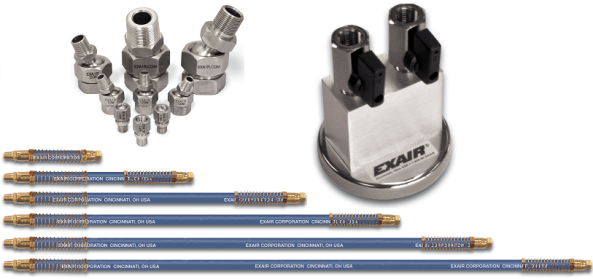
Swivel Fittings, Stay Set Hoses and Magnetic Bases – To provide a great degree of flexibility for positioning an EXAIR Super Air Nozzle, Air Jets or Air Amplifiers, EXAIR offers several items.  The Swivel Fittings have 25 degree of movement from the center axis, providing a total of 50 degree of adjustability.  The position is locked in place and holds until adjustment is needed. For applications where frequent re-positioning of the air device is required, the Stay Set Hoses are ideal.  Simply mount the hose close to the application, bend it to the shape preferred, and because the hose has “memory”, it will not creep or bend.  Lastly, the Magnetic Bases are another option for flexible, movable installations.  The base has a on/off valve, and a powerful magnet to hold in any vertical or horizontal mounting arrangement.

Swivels, StaySets,MagBases2


Hoses – EXAIR can provide hoses for your application.  For the Line Vac air operated conveyor applications, we offer conveyance hose – a durable, clear reinforced PVC hose, in diameters of 3/8″ to 3″ ID, and lengths up to 50′. On the compressed air side, we can provide 12′ Coiled Hoses with 1/8, 1/4, and 3/8 NPT connections, and also 3/8″ and 1/2″ ID hose in lengths to 50′.

Hoses

Filter Separators, Oil Removal Filters and Pressure Regulators – Perhaps the most important accessories for use on a compressed air device are filters and regulators. Filtering the compressed air of dirt, debris, moisture and oil will help to prevent build up inside the EXAIR products, leading to longer service life, and less time spent cleaning, while providing optimum performance. Regulating the air pressure allows for tuning of the performance, using the proper amount of compressed air to obtain satisfactory results.

Filter and Regualtors

If you have questions regarding accessories for use with any EXAIR Intelligent Compressed Air® Product, feel free to contact EXAIR and myself or one of our Application Engineers can help you determine the best solution.

Brian Bergmann
Application Engineer

Send me an email
Find us on the Web 
Like us on Facebook
Twitter: @EXAIR_BB

EXAIR Electronic Flow Control: Phase 3 for improving medical devices.

Medical Anatomy

As we started this journey on improving the processes with this medical device company, I wanted to touch base on one more area that EXAIR was able to help: Saving Money.  In the previous two blogs, I showed how EXAIR’s products helped the machining process by reducing scrap with the Stay Set Ion Air Jet (you can read it here: Phase 1) and by increasing production rates with the Mini Chip Vac (you can read it here: Phase 2).  But now I want to show you how EXAIR was able to save them money by reducing their compressed air usage; Phase 3.  Our goal at EXAIR is to use the least amount of compressed air to solve your process problems.  It costs a lot of money to make compressed air.  So, if you can reduce the amount being used, then your overhead costs are reduced.

Electronic Flow Control

A process with time delays or gaps is usually a candidate for wasting compressed air.  This is a hidden profit-reducing culprit that is not well recognized.  I like to correlate it to why the refrigerator light goes out when you shut the door.  When it is not required, then it shouldn’t be on.  With the previous discussions about the machining center, I did recognize that they did have time gaps in their process.  They could turn off the compressed air during loading and unloading of the parts to save money.  This may not seem like a lot of time, but during an 8 hour shift, it can really add up.  My suggestion was to use the Electronic Flow Control (EFC).

The EFC is a miniature PLC that controls a solenoid valve with 8 different timing sequences.  It utilizes a photo-sensing eye to trigger the timing cycle when it detects the part.  The timing is selectable from milliseconds to hours to optimize the on/off time of the solenoids.  I recommended the model 9055-2 which is an EFC that has two solenoids attached.  The customer attached one solenoid to the Mini Chip Vac and the other to the Stay Set Ion Air Jet.  They knew the timing sequence of the machining operation, so they were able to input that time into the EFC.  The photo-sensing eye was attached near the door of the machine to trigger the EFC.  Once the door was closed, the machining operation started as well as triggering the EFC.  This would turn on both solenoid valves to operate the Stay Set Ion Jet and the Mini Chip Vac.  When the operation was over, both of the EXAIR products would turn off.  This cycle would repeat for each operation throughout the day.  Since the EXAIR products do not have any moving parts, the instant on and off would not affect the operation of the EXAIR Stay Set Ion Air Jet and Mini Chip Vac.

With the addition of the EFC, they were able to project a savings of $6,000 a year, just by turning off the compressed air between cycles.  With a pay back of only 4 months, this was a nice bonus for the medical company, as this additional money was not appropriated.  Not only did they see their cost of operation reduced by less scrap and faster production rates; but, they could add this hidden gem of money right to the bottom line.  If you have stop gaps in your operation, you could get that added bonus to your profits by turning your compressed air off with the EFC.

John Ball
Application Engineer

Email: johnball@exair.com
Twitter: @EXAIR_jb


Photo: Muscles Anatomy Medical Human by Heblo/64 CC0 Public Domain

The Victory is in Solving the Problem, No Matter the Size

I had an engineer from a welding company contact me about his application.  He was already using three EXAIR Super Air Knives for a cooling application.  He had the Super Air Knives mounted in a linear fashion, two model 110018 18″ Super Air Knives and a model 110012 12″ Super Air Knife. His system was designed to operate the different Super Air Knives to cool the corresponding tubes length after a welding operation.  (He purchased the EXAIR Super Air Knives because he wanted the best air cooling capacity with the highest efficiency.)

Super Air Knife

Because it was an automated system, timing was critical.  The system was designed to operate one 18″ Super Air Knife for an 18″ welded tube.  For a 36″ long tube, they would turn on both the model 110018 Super Air Knives.  For their longest tube, they would activate all three Super Air Knives to cool the 48″ welded seam.  The engineer was extremely happy with the effectiveness and the consistency of the Super Air Knives that he was able to create a timing sequence in his automated operation for a repeatable and reliable cooldown of the welds.

So, why did he decide to contact EXAIR? I was thinking the same thing when he was giving high praises about the EXAIR Super Air Knives.  It was because of their compressed air system.  In another section of the plant, they would use large air vibrators to break loose powder from a hopper.  These vibrating devices would use a large quantity of compressed air when they were turned on.  During this time, the compressed air system would drop in pressure throughout the plant. This would change the amount of compressed air available for his application; affecting his timing sequence to get adequate cooling.

EXAIR Digital Flowmeter

Since that the engineer was happy with the efficiency and quality of our Super Air Knives, it was an easy decision for him to contact EXAIR about the Digital Flowmeters. He wanted to measure the amount of air flow to each Super Air Knife and continuously monitor the system for any low-flow conditions.  Since he was supplying the Super Air Knives with ½” NPT piping, he requested the model 9090 ½” Digital Flowmeter for each Super Air Knife.  I explained that the EXAIR Digital Flowmeters are very accurate and easy to install.  They have different ways to monitor the compressed air flow; 4 – 20 mA analog output, serial connection, or a Datalogger.  Since his PLC system had an analog reader, our Digital Flowmeters could supply the analog signal for flow measurements.   Currently the PLC was operating the solenoids to turn on and off sections of the Super Air Knives to cool the desired length of welds.  Now, he was looking to measure the amount of air flow with the PLC to verify that they did have adequate compressed air flow to the Super Air Knives.  If the flow was not sufficient, then he could trigger an alarm to delay the welding operation.  So, when the vibrators went offline, then they could restart their operation.

EXAIR routinely maximizes compressed air efficiency in an effective manner and I recommended, as an alternative, that he could use one 1½” Digital Flowmeter, model 9094, to monitor the air flow to all three Super Air Knives.  This would save him a lot of cost for his project in purchasing one larger Digital Flowmeter instead of three smaller ones.  Also, with the resolution of the flow meter and his ability to utilize the 4 – 20 mA analog signal, he could easily determine the required flow to one Super Air Knife, two Super Air Knives, or all three.  In the end, he was quite impressed with my recommendation to keep his system operating, even during times of depletion in his compressed air system.

At EXAIR, our first priority is to help the customer to correct their compressed air issues.  For this engineer, he was able to mount one Digital Flowmeter to monitor the compressed air flow to all three Super Air Knives. If you need real solutions to your compressed air applications, you can contact an Application Engineer at EXAIR, and perhaps we can also reduce your project cost in the process.

John Ball
Application Engineer
Email: johnball@exair.com
Twitter: @EXAIR_jb