Industrial Safety: Compressed Air

At EXAIR, we have a statement that says, “Safety is everyone’s responsibility.”  EXAIR builds its name around manufacturing safe and protective compressed air products.  In the United States, we have an organization called the Occupational Safety and Health Administration (OSHA) that enforces governmental directives for safe and healthy working environments.  They do training, outreach programs, and educational assistance for manufacturing plants to reduce injuries and fatalities.  They can also enforce these directives with heavy fines for violations.  With compressed air systems, the two most common violations are 29CFR 1910.242(b) for dead-end pressure/chip shielding and 29CFR 1910.95(a) for maximum allowable noise exposure.

Unsafe Nozzle

Here is an example of a nozzle that is dangerous.  As you can see, there is only one path where the air can pass through.  Other similar types of blow-off devices that would fall into this same group would include copper tubes, flexible lines, and open pipes.  They are dangerous as compressed air cannot escape if it is blocked by your body or skin.  If operated above 30 PSIG (2 bar), these nozzles could penetrate the skin and create an air embolism within the body, which can cause bodily harm or death.  This is a hazard that can be avoided by using EXAIR Super Air Nozzles and Safety Air Guns.  The nozzles are designed with fins, which allow the air to escape and cannot be blocked by your skin.  So, you can use the EXAIR Super Air Nozzles safely above 30 PSIG (2 bar) and remain OSHA compliant.

Unsafe Air Gun

To counteract the dead-end pressure violation, some nozzle manufacturers create a hole through the side of the nozzle (reference photo above).  This will allow the compressed air to escape, but now the issue is noise levels.  With an “open” hole in the nozzle, the compressed air is very turbulent and very loud.  The National Institute for Occupational Safety and Health (NIOSH) states that 70% to 80% of all hearing loss within a manufacturing plant is caused by compressed air.  OSHA created a chart to show the maximum allowable noise exposure.  This chart shows the exposure time and noise limits before hearing protection is required.  The EXAIR Super Air Nozzles, Super Air Knives, and Super Air Amplifiers are designed to have laminar flow, which makes them very quiet.  As an example, the model 1210 Soft Grip Safety Air Gun has a sound level of only 74 dBA, well under the noise exposure limit for 8 hours.

One of the last things that companies think about when purchasing compressed air products is safety.  Loud noises and dead-end pressure can be missed or forgotten.  To avoid any future fines or having to purchase additional personal protective equipment (PPE), it will be much safer to purchase EXAIR products.  If you would like to improve the safety of your facility and reduce energy costs, an Application Engineer at EXAIR can review your current blow-off devices.  Remember, safety is everyone’s responsibility. 

John Ball
Application Engineer
Email: johnball@exair.com
Twitter: @EXAIR_jb

Photo: Industrial Security Signal by DavidRockDesignPixabay license

5S + Constant Evolution = 6S

A sticker on my dad’s old lunch box. I still use the lunchbox today. He worked for a steel mill in maintenance for more than 35 years. This was from one of their many safety program pushes.

6S is a standard in many facilities. This standard spawns from the Lean Manufacturing and Six Sigma standards of 5S. Of course, it adds one more characteristic to it: the sixth S, Safety. Back in 2006, I achieved a Green Belt in Six Sigma and Safety was mentioned a good amount as a driver for several of the processes. The fact Safety was not one of the fives shows two things, I’m getting older and getting closer to that age where I have been out of school longer than I was in; and Safety is and should be a top priority, maybe it always should have been.

In case you have never been introduced to Lean Manufacturing or Six Sigma, this principle focuses on a single piece flow and optimizing a work process to minimize the amount of time it takes. This increases efficiency in the manufacturing process and ultimately puts money back into the bottom line of the business.

The first S is Sort, you should remove anything that is not needed for the production process, this could be additional tooling or resources that are not needed for the specific work station or task. This prevents any kind of clutter or confusion on what is needed.

The second S is Set In Order, just like the photo above, every tool and bin should have it’s place at the work station. This helps operators find what they need when they need it. The outlines also give a visual indicator to any tool or device that may be missing and or in use. Again, it helps with the operators time efficiency and reduces risk of leaving a tool in a process.

Third is SHINE, every aspect of a work area should be cleaned up, sometimes this needs to be done throughout the shift and other times just at the end of the shift to put everything back in place and prepare for the next operator or day. When I worked in retail I would hear managers tell people, “You have time to lean, you have time to clean.” and while it isn’t the best approach, it is a true statement. This does contribute to keeping production running at high efficiency, being able to spot leaks or wear issues on equipment that aren’t caked in chips, grease, and used fluids. It can also aid with safety by preventing slips or falls from a leak or debris building up from a process.

Fourth, Standardize, this means all work areas should look the same, maybe not the exact same tools, or process, but any operator should be able to walk into a work station, read the documentation, and be able to function sufficiently. This also helps to keep the old ways of tribal knowledge from happening which will prevent changes and adjustments from not being documented and will help to reduce learning curves when changes happen.

Fifth, Sustain, this is one of the hardest. This means the standards that have been set in place are kept. Repetition is key in a scenario where 5S or 6S are being implemented and even where they have been set in place for a while. Revisiting the standards and ensuring they are aligned to production and operator needs is always good.

A Safety Sticker from my dad’s 1988 lunchbox that I still use to this day. They were running safety programs before it was cool.

Sixth, Safety, this should always be at the forefront of any process. Being able to keep operators safe during a work day is always a high priority and one of the many ways to do that is to use the other five Ss to make sure that they can efficiently and safely work throughout their day.

Whether it is replacing open pipe blowoffs with engineered nozzles, cross drilled blowguns with Safety Air Guns, installing Line Vacs to help evacuate trim or debris, Super Air Amplifiers to cool down a part before it is being handled. I’ve even helped customers with custom length air hoses to ensure their operators can’t reach the air hose into a process too far in order to ensure operator safety. EXAIR is always focused on safety and ensuring our products help increase process efficiency. If you want to see how we can help you and your team, contact an Application Engineer today.

Brian Farno, MBA – CCASS
National Business Development Manager

BrianFarno@EXAIR.com
@EXAIR_BF

Compressed Air Use in the Medical Industry

EXAIR uses many different methods to connect with our customers.  We have our website, social media, blogs, publications etc. We like to share solutions to some of the most common pneumatic problems in industry.  EXAIR generates a large collection of application information where EXAIR products have already solved problems and improved processes. We organized them by Application and by Industry.  In this blog, I will show you how to use our Application database; specifically, for the Medical Industry.

Vortex-based products used to cool skin during air removal laser surgery

Compressed Air Systems are considered to be a fourth utility within industries because they use a large amount of energy.  Whether an air compressor that uses fuel for portable units or that uses electricity, it is important to use this system as efficiently as possible.  This would also apply to the automotive industry.  EXAIR has a library of different processes in which we have already improved these areas safely and efficiently.  If you are part of the automotive industry, it could benefit you to take a peek at the areas that we have already improved, established OSHA compliant safety measures, and saved money.

Drying medical Bins with the Super air Amplifier!

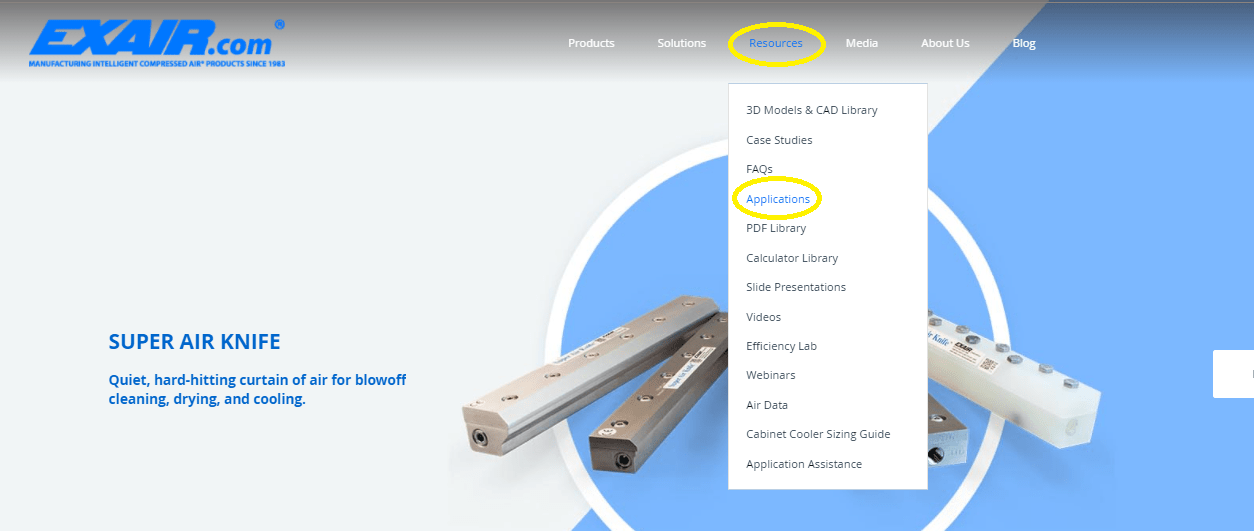
Here is how you can find this library.  First, log into EXAIR.com.  Click here: Log In.  Once you fill in the proper information, you can then retrieve tremendous amounts of resources about EXAIR products.   The Application database is under the Resources tab.  (Reference photo below).

EXAIR Application Data Base

Within the Application Search Library, we have over one thousand applications referenced.  In the left selection pane, we organized them in alphabetical order under two categories: Application and Industry.

Scroll down in the selection pane until you come to the sub-category: Industry.  Under this Sub-category, you will find three selections that are related to this blog: Medical, Health and Beauty, and Healthcare.  We have other applications as well that may relate to your specific processes if you scroll up and down the list. You will find many product applications that have already improved processes and solved problems.

Why is this important?  If you are a plant manager or owner, the value of the Application Database can improve your current processes with pre-qualified results.  Within the automotive industry, simple solutions can be found to address those “nagging” issues that you see every day.  For crisis situations and shutdowns, EXAIR categorized these applications in a way to reference quickly and easily.  And since EXAIR has a high volume of stocked items, we can get the parts to you very fast, so you can quickly be on your way to a solution.

In today’s market, companies are always looking for ways to cut cost, increase productivity, and improve safety.  EXAIR offers engineered products to do exactly that.  With the “been there and done that” solutions already described in the Application Database, you can have confidence in finding a way of solving pneumatic issues.  If you do not sign up at www.EXAIR.com and take advantage of these offerings, you will be missing out on a great tool to optimize your compressed air system.

Jordan Shouse
Application Engineer

Send me an Email
Find us on the Web 
Like us on Facebook
Twitter: @EXAIR_JS

Industrial Safety: Compressed Air

We have a statement that says, “Safety is everyone’s responsibility.”  EXAIR builds its name around this by manufacturing safe and protective compressed air products.  In the United States, we have an organization called the Occupational Safety and Health Administration (OSHA) that enforces governmental directives for safe and healthy working environments.  They do training, outreach programs, and educational assistance for manufacturing plants to reduce injuries and fatalities.  They can also enforce these directives with heavy fines for violations.  With compressed air systems, the two most common violations are 29CFR 1910.242(b) for dead-end pressure/chip shielding and 29CFR 1910.95(a) for maximum allowable noise exposure.

Unsafe Nozzle

Here is an example of a nozzle that is dangerous.  As you can see, there is only one path where the air can pass through and be blocked.  Other similar types of blow-off devices that would fall into this same group would include copper tubes, flexible lines, and open pipes.  They are dangerous as compressed air cannot escape if it is blocked by your body or skin.  If operated above 30 PSIG (2 bar), these nozzles could penetrate the skin and create an air embolism within the body, which can cause bodily harm or death.  This is a hazard that can be avoided by using EXAIR Super Air Nozzles and Safety Air Guns.  The nozzles are designed with fins, which allow the air to escape and cannot be blocked by your skin.  So, you can use the EXAIR Super Air Nozzles safely above 30 PSIG (2 bar) and remain OSHA compliant.

Unsafe Air Gun

To counteract the dead-end pressure violation, some nozzle manufacturers create a hole through the side of the nozzle (reference photo above).  This will allow the compressed air to escape, but now the issue is noise level.  With an “open” hole in the nozzle, the compressed air is very turbulent and very loud.  The National Institute for Occupational Safety and Health (NIOSH) states that 70% to 80% of all hearing loss within a manufacturing plant is caused by compressed air.  OSHA created a chart to show the maximum allowable noise exposure.  This chart shows the exposure time and noise limits before hearing protection is required.  The EXAIR Super Air Nozzles, Super Air Knives, and Super Air Amplifiers are designed to have laminar flow, which makes them very quiet.  As an example, the model 1210 Safety Air Gun has a sound level of only 74 dBA, well under the noise exposure limit for 8 hours.

NIOSH created an overview of how to handle hazards in the workplace.  They call it the Hierarchy of Controls to best protect workers from danger.  The most effective way is by eliminating the hazard or by substituting the hazard.  The least effective way is with Personal Protective Equipment, or PPE.  For unsafe compressed air nozzles and guns, the proper way to reduce this hazard is to substitute it with an engineered solution.

One of the last things that companies think about when purchasing compressed air products is safety.  Loud noises and dead-end pressure can be missed or forgotten.  To avoid any future fines or having to purchase additional personal protective equipment (PPE), it will be less expensive and a preferred safety strategy to purchase EXAIR products.  As in the above Hazard Hierarchy of Controls chart, EXAIR products are that engineered solution.  If you would like to improve the safety of your facility and reduce energy costs, an Application Engineer at EXAIR can review your current blow-off devices.  Remember, safety is everyone’s responsibility. 

John Ball
Application Engineer
Email: johnball@exair.com
Twitter: @EXAIR_jb

Picture:  Safety First by Succo.  Pixabay License