ROI Calculation

What’s in it for me? We’ve probably all asked this question at some point or another, especially when trying to justify a big change or expenditure. Is it going to be worth it? What benefit am I going to get out of it?
Here at EXAIR we are confident that there is a lot to gain from using our products. Two of the biggest benefits of our Intelligent Compressed Air Products are a reduction in noise, and a reduction in Compressed Air usage. The latter will often lead to big money savings. Many times the savings our products offer will pay for the product itself! This is where ROI calculations come in. What is my Return on Investment going to be?

So, how do you calculate your ROI? The easy answer is that you don’t have to! You can use our Air Savings Calculator to calculate your savings for you. If you know your current air consumption (in SCFM), the new air consumption (SCFM) and the cost of the product, our calculator will turn that into monetary savings, as well as the calculated payback time in days.

Another option, if you would rather not do the calculations yourself, is that you can send the item in question to our Efficiency Lab. The Efficiency Lab Testing is a free service that we offer to show you the possible savings by switching to one of our products. We will calculate the savings for you and send you the results of our findings.
The final option – my favorite by the way – is that we can do the math right here:

For a simple example of a blowoff application, I’m going to show the ROI of replacing a drilled copper pipe with an EXAIR Super Air Knife. The calculations will be as follows:

Copper Pipe (1/4”): 3x 3/32” diameter drilled holes uses 9.4scfm per hole (28.2scfm total) at 80psig.

3” Super Air Knife: uses 8.7scfm at 80psig

Calculation:

For the yearly consumption, we need to find how many minutes in a year the blowoff will be operated:

For the Copper Pipe, the yearly consumption would be:

For the 3” Super Air Knife, the yearly consumption would be:

The difference between these two:

At this point, if you know your facilities cost to generate 1,000scf, you can use that to calculate how much you would save. For this example, we will use $0.25 to generate 1,000scf, which is used by the U.S. Department of Energy to estimate costs. This gives the following yearly savings:

With an investment of $273.00 (at the time of publishing), you can calculate the time it would take to pay off the unit:

From these numbers you can see that after only 117 days the 3” Super Air Knife will have paid for itself. After that, it is all money being put towards your bottom line.

If you have any questions or want more information on EXAIR’s Air Knifes or how our products could save you money, then give us a call. We have a team of application engineers ready to answer your questions and recommend a solution for your applications.

Al Wooffitt
Application Engineer

Send me an Email
Find us on the Web
Like us on Facebook
Twitter: @EXAIR_AW

Air Nozzles and Jets Stay Set Hoses

Very few applications are exactly alike. In fact, many applications have very specific needs; only a certain material will work, or a specific amount of force is needed, or the air flow needs to be directed at just the right location. You will have a hard time finding more flexibility and customization than with our Air Nozzles and Jets when combined with our Stay Set Hoses.

 EXAIR’s Air Nozzles come in a variety of materials, including Zinc-Aluminum, Stainless Steel Type 303 and 316, Brass, and PEEK (plastic). Each of the materials will cater to different situations – PEEK is non-marring for working with sensitive products. Stainless steel can withstand high temperatures when that is a concern.
In addition to multiple materials, EXAIR’s Air Nozzles can also produce a wide range of forces from 2oz all the way up to 23lbs. Whether you need a precise blowoff, or a forceful blast, we have you covered. With all of these variations, we have over 70 different nozzles to choose from!


Even with all of these options, there is one thing all of EXAIR’s Air Nozzles and Jets have in common. They are all designed to be compliant with OSHA 1910.242(b), which states “the use of compressed air for cleaning purposes at pressures at or greater than 30 psi is permissible if the outlet or source is fitted with a relief device that drops the pressure to less than 30 psi if the flow is dead-ended”. Our design achieves this by preventing the openings from being blocked off. This also has the added benefit of helping entrain the ambient air, making them very efficient in their compressed air usage.

Once you add in our Stay Set Hoses, the customization increases exponentially. Our Stay Set Hoses have a memory function, so they won’t creep or droop until you physically move them. They are perfect for directing the air flow in a particular direction, or at a specific target. The Stay Set Hoses come in lengths from 6” (15cm) to 36” (91cm), and they have threaded connections with either 1/4” NPT male on both ends or with a 1/8” NPT female X 1/4” NPT male thread.  The hoses are made from reinforced synthetic rubber and have a maximum pressure rating of 250 PSIG.

Flexible and durable, EXAIR Stay Set Hoses come in lengths from 6″ to 36″.

Whatever the specifics of your application are, we are sure to have a great solution. If you would like to discuss options for your application, feel free to contact me.

Al Wooffitt
Application Engineer

Send me an Email
Find us on the Web
Like us on Facebook
Twitter: @EXAIR_AW

How EXAIR Uses Fluidics To Make Efficient, Quiet, and Safe Compressed Air Products

EXAIR Intelligent Compressed Air Products incorporate several distinct principles of fluidics into our engineered designs. To be clear, these principles aren’t exclusive to making quiet and efficient compressed air products. I personally have used them all for business and pleasure over the years. In the Navy, for example, the air ejectors that pulled vacuum on the main condensers where our turbines dumped their ‘used’ steam were basically great big Venturis – they restricted the diameter through which a fluid (steam, in this case) flowed, gradually increased that diameter, and doing so, changed the velocity so that a low pressure area (or vacuum) developed in the throat:

Graphic representation of the Venturi effect.

EXAIR E-Vac Vacuum Generators use the Venturi effect to draw vacuum of up to 27″Hg. They’re typically used with Vacuum Cups for pick-and-place material handling applications.

Here are a few examples of Mr. Venturi’s discovery, implemented in modern industry.

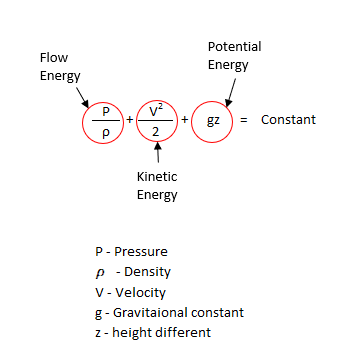
I first learned about the Bernoulli principle on a grade school field trip to the National Air Force Museum at Wright Patterson Air Force Base, about an hour from where I grew up. See, this Bernoulli guy discovered that when there is an increase in the speed of a fluid, a simultaneous decrease in fluid pressure occurs at the same time. That’s why airplane wings are shaped like they are – flat on the bottom and curved on top…when the air flowing that extra distance over the top speeds up to get to the back of the wing as fast as the air that’s simply flowing underneath the wing does, the decrease in pressure on top causes the wing (and the plane it’s attached to) rise in the air.

Bernoulli’s Equation: this is the math that proves it works.

The Bernoulli principle is incorporated in to the design & operation of EXAIR engineered Air Knives, Air Wipes, Air Amplifiers, and Air Nozzles.

The Coanda effect is the third fluidics principle that’s incorporated into the design & operation of many EXAIR engineered compressed air products. Its namesake, Henri Coanda, was an early 20th Century aeronautical engineer who discovered that if a jet of fluid exiting an orifice flows across a surface, it’ll tend to not only adhere to and follow that surface (even if it curves or bends), but also entrain fluid from the surrounding area.

EXAIR Intelligent Compressed Air Products such as (left to right) the Air Wipe, Super Air Knife, Super Air Nozzle, and Air Amplifier all use the Coanda effect to entrain enormous amounts of air from the surrounding environment.

There are a couple of easy – and interesting – experiments that demonstrate the Coanda effect, both of which I used when I was a Cub Scout leader and our Pack’s Webelos den was earning their Science Activity Pin:

Turn a faucet on and let the running water flow over the convex ‘bottom’ of a spoon. Everything we know about the laws of gravity say that when the water reaches the ‘bottom-most’ point on the spoon’s convex surface, it ought to fall straight down…but it doesn’t:

Another experiment that defies everything we think we know about gravity can be performed with a ball, and a source of air flow. Here’s a short video, showing how the air flow from an Air Amplifier ‘wraps’ around a ball and holds it in that jet of air:

The Webelos den did this with a leaf blower and a playground ball. Unlike a lot of things I’ve done, I DEFINITELY encourage you to try THAT at home.

For forty years now, EXAIR has been putting these principles of fluidics into practice by engineering & manufacturing the most efficient, quietest, and safest compressed air products on the market. If you’d like to find out how we can help you get the most out of our products – and your compressed air system – give me a call.

Russ Bowman, CCASS

Application Engineer
Visit us on the Web
Follow me on Twitter
Like us on Facebook

TurboBlast Safety Air Guns – Up To 23 Pounds Of Force At The Push Of A Button

I had the pleasure, recently, of talking with a customer at a paper good manufacturing facility who needed an air gun with a LOT of force for some applications, a little less for others, and was hoping to find one device that gave the operator control over it. They were using a piece of 1/2″ pipe on the end of a ball valve. The operators were trying (and mostly failing) to get precise control by throttling that valve. When they needed a LOT of force, it was no problem – just open the valve all the way. Unfortunately, though, ball valves aren’t known for being precision throttling devices, so most of the “little less” force jobs were getting too much force (and making a bigger mess) or not enough (leaving the existing mess) around the machinery.

After reviewing our Safety Air Guns catalog, they decided to try the Model 1927 TurboBlast Safety Air Gun. They liked:

  • Hard hitting power – the Model 1118 High Force Super Air Nozzle‘s flow (when supplied @80psig) generates 15 pounds of force at a distance of 12″ from the target.
  • Nozzle Guard – there was a great potential for the tip to get banged up from incidental contact with the machinery. The rugged Nozzle Guard protects not only the Air Nozzle, but the equipment as well, as the Zinc Aluminum Super Air Nozzle could have left scratches in some of the parts that were painted.
  • Adjustable Gate Valve – this provides the precise control their operators need to clean up the aforementioned mess, without creating a bigger one.
  • Pushbutton control – the low profile button trigger actuates with just a slight squeeze. Much more ergonomic than having to grasp the ball valve’s handle tight, especially when they needed it in a partially open position.
Features & benefits of the new TurboBlast Safety Air Gun

No matter what the scope of a blow off application is, EXAIR has a wide selection of Safety Air Guns to meet your needs. If you’d like to find out more, give me a call.

Russ Bowman, CCASS

Application Engineer
Visit us on the Web
Follow me on Twitter
Like us on Facebook