Intelligent Compressed Air: Save $$ With a Leak Prevention Program

waste
Don’t let leaks drive up your utility bill

The generation of compressed air accounts for approximately 1/3 of all energy costs in an industrial facility. According to the Compressed Air Challenge, about 30% of that compressed air is lost through leaks. This means nearly 10% of your facility’s energy costs are simply wasted through poor connections, faulty air valves, improper installation, etc. In addition to simply wasting money, compressed air leaks can also contribute to a variety of other operating losses. A leak can cause a drop in system pressure. When this occurs, end users may not operate as efficiently, having an adverse effect on production. This same drop in system pressure will also cause the equipment to cycle on/off more often, shortening the life of your compressor and other equipment. If the leaks cause an issue in supply volume, it may lead to the belief that more compressor capacity is necessary, further increasing your operating costs.

To put leaks in perspective (assuming energy costs of .10/ kWh), the Compressed Air Challenge states this:

  • A $200/year leak cannot be felt or heard
  • A $800/year leak can be felt, but not heard
  • A $1,400/year leak can be felt and heard.

If you walk through your facility, how many leaks can you hear?

We know that a large portion of the compressed air is being wasted, but what do we do about it? A proper leak prevention plan is the key to success. Since these leaks are impossible to see and some cannot even be heard, you need a tool to help assist you. EXAIR’s model 9061 Ultrasonic Leak Detector is the right tool for the job. When compressed air leaks through a pipe, it creates an ultrasonic signature due to turbulence. While this sound is not always detectable by the human ear, this meter will allow you to locate leaks up to 20’ away.


ultrasonic_2
Model 9061 with parabola attachment

The first step will be locating the leaks using an Ultrasonic Leak Detector and tagging them throughout the facility. Don’t let this overwhelm you!! If you have a larger facility, break it up into sections that can be completed in 1 day. This will allow you to decide which areas of the plant should be looked at first. Once you’ve located and tagged all of the leaks, rate them under two separate criteria so that you can prioritize what to fix first. Rate them based on the difficulty that it will take to fix them and also by the severity of the leak. Those that are severe yet easy to fix would make sense to begin fixing first. Those that may require a period of shutdown can be planned to fix at a more appropriate time.

ULD_Kit
Accessories that come with the Ultrasonic Leak Detector

When you’ve had the opportunity to fix them, don’t just forget about it. When new piping is installed, new lines are added, or anything involving compressed air is installed there is the potential for new leaks to develop. Set this as one of your regular PM activities and complete your own compressed air audit once a year. Implementing the process and maintaining it are the keys to your success.

If you have questions about developing a leak program or how to use the Ultrasonic Leak Detector, give us a call. An Application Engineer will be happy to help with the process and recommend additional methods to save on your compressed air supply.

Tyler Daniel
Application Engineer
E-mail: TylerDaniel@EXAIR.com
Twitter: @EXAIR_TD

Reduce, Reuse, Recycle

I think we have all heard the mantra Reduce, Reuse, Recycle – a phrase that is thought to have originated back in 70’s when environmental protection became a governmental policy.

We at EXAIR can help your company follow this important principle and help to keep your costs down as well.

5837677046_de363440a3_z

Reduce – Reduce the number of times you change out your coolant, reduce your wastewater. Our Reversible Drum VAcs and Chip Trappers help keep your coolant clean by providing a simple and effective method to remove and/or strain your coolant.

Also, remember this – they are VERY hard to break or ruin. If you have one of our liquid handling Reversible Drum Vacs or Chip Trapper units, and the performance isn’t quite as you remember it to be, give us a call.   We can help to trouble shoot and narrow in on the root cause.  Most of the time, it is a simple fix, such as a air leak or a change to the air supply system that has caused a drop in performance. If we have eliminated all of those possible causes, we can offer the RDVREFURB option. Simply send in your Reversible Drum Vac pump unit, and we will do a free evaluation. Then we’ll let you know what we find, and provide a quote for the repair.  The repair typically involves a thorough cleaning, replacement of a few basic parts, and then setting and testing to original factory specification.  Because the unit has no moving parts, there isn’t much that can break down or go wrong.  Don’t throw away that unit, REDUCE the amount of waste you create.

6091

Reuse – Maybe you have a Super Air Knife in storage that is not in use, and you come up with a need, but the Knife doesn’t quite match the application.  We can provide new custom shim to change the air flow pattern.  Perhaps you have a 24″ Super Air Knife, but the new application requires only 18″ of airflow.  You can send the knife in and we can clean it up and install a new custom shim to provide the exact airflow pattern that meets your requirements.  Or, we can send the new shim directly to you for your team to install. Don’t let the unused product lie around, REUSE it for another process or application.

Super Air Knife

Recycle – If for what ever reason a product has been deemed to be no-longer viable and cannot be reused, the time comes to dispose of it.  We hope that you would take the time to recycle it properly. With materials of construction including brass, aluminum and type 303 and type 316 stainless steels, most EXAIR products can be RECYCLED as common metals and you may even get a little money back!

To discuss your processes and how an EXAIR Intelligent Compressed Air Product can provide a beneficial service, feel free to contact EXAIR and myself or one of our other Application Engineers can help you determine the best solution.

Brian Bergmann
Application Engineer

Send me an email
Find us on the Web
Like us on Facebook
Twitter: @EXAIR_BB


Photo Credit – “Recycling” by Andy Arthur is licensed under CC BY 2.0

Many Ways to $ave on Compressed Air Costs

Using compressed air in the plant is common for many types of processes.  Typical uses are drying, cooling, cleaning and conveying. Compressed air does have a cost to consider, and there are many ways to keep the usage and the costs as low as possible.  The first step is to use an EXAIR Intelligent Compressed Air Product, which has been engineered to provide the most performance while using the least amount of compressed air. The next step is to control the use of the air, to only have it on when needed.

EXAIR offers the EFC – Electronic Flow Control.  It offers the most comprehensive method to maximize the efficiency of compressed air usage.  It combines a photoelectric sensor with a timing control that operates a solenoid valve to turn on and off the air as required. With 8 different program types, an on/off mode that works with any process can be programmed ensuring that the minimum amount of compressed air is used.  You can use the online EFC Savings Calculator to see how quickly the savings add up!

EFCp4
EFC – Electronic Flow Control

Another method would be to use a solenoid valve with some other method of control. Depending on the process, the solenoid could be energized via a machine control output, or as simple as an electrical push button station. EXAIR offers solenoid valves in a variety of flow rates (from 40 to 350 SCFM) and voltages (24 VDC, 120 VAC and 240 VAC) to match the air flow requirements of the products we provide, while integrating into the facility and available supply voltages.

For control of the Cabinet Cooler Systems, the ETC – Electronic Temperature Control, uses a thermocouple to measure cabinet temperature and cycle the system on and off to maintain a precise cabinet temperature, and provides a digital readout of the internal temperatures and on the fly adjustment.  Also available is the Thermostat Control models, which utilize an adjustable bimetallic thermostat to control the solenoid valve, also cycling the unit on and off as needed to maintain a set cabinet temperature.

ETC CC
ETC – Electronic Temperature Control

There are several manual methods that can be used to control the compressed air.  A simple valve can be used to turn the air off when not needed, whether at the end of the work day, at break time, or whenever the air isn’t required.  We offer several options, from a foot controlled valve, to a magnetic base with on/off valve, to a simple quarter turn ball valve.

footpedalvalve (2)dualstand (2) manual_valves (2)


To discuss your processes and how an EXAIR Intelligent Compressed Air Product can control the air supply and save you money, feel free to contact EXAIR and myself or one of our other Application Engineers can help you determine the best solution.

Brian Bergmann
Application Engineer

Send me an email
Find us on the Web
Like us on Facebook
Twitter: @EXAIR_BB


Stop Trying To Squeeze More Out Of That Air Gun!

At EXAIR, we LOVE to talk about efficient use of compressed air. That’s why I was thrilled to get a call from an engineer that works for a non-profit firm that promotes energy efficiency to enable businesses in their area improve sustainability, improve the environment, and save money.

They were working with a local company to, among other things, optimize their use of compressed air and wanted to take advantage of our free Efficiency Lab service to get the “before” data on the current blow off devices.

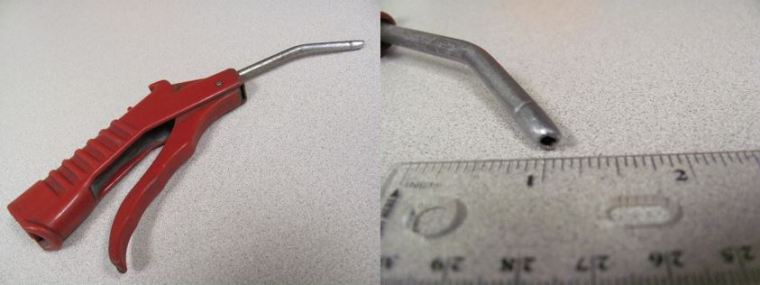
Don't let this happen to your air gun...use an EXAIR Precision Safety Air Gun with a quiet, efficient Super Air Nozzle instead.
Don’t let this happen to your air gun…
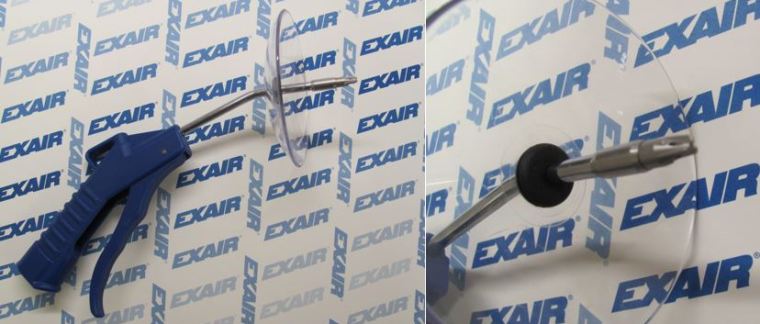
Squeeze the trigger on a Model 1410SS Precision Safety Air Gun with Nano Super Air Nozzle instead!

As you can see, they were trying to “squeeze” a little more performance out by, literally, squeezing the tip down.  Thing is, it’s STILL loud and non-compliant with OSHA’s regulations about dead end pressure.  And as far as performance goes, this results in only a slight change in the air flow pattern, with a minimal reduction in compressed air consumption…they’ve changed the geometry of the discharge opening, but not the cross sectional area.  Our Efficiency Lab Test results provide the final answer:

cry for help lab

Efficiency. Saving money. Safety. Sustainability. “Going Green.”   If you’d like to talk about how EXAIR can help you with any…or all…of these things, give me a call.

Russ Bowman
Application Engineer
EXAIR Corporation
Visit us on the Web
Follow me on Twitter
Like us on Facebook