
Not All Compressed Air Guns Are The Same

If you work in an industrial plant or manufacturing environment, chances are you use some type of compressed air gun for cleaning parts, work areas, etc. Many air guns purchased through large industrial suppliers are a common choice due to the cost of the gun but as the saying goes – “you get what you pay for”. These types of guns may be cheap to purchase but they are also made cheap and have parts that can break easily, like the trigger or nozzle. In many cases, the nozzles on these guns are also in violation of OSHA requirements, producing dangerous discharge pressures and loud noise levels, which can lead to costly fines or potentially deadly injuries.

EXAIR offers 5 different styles of Safety Air Guns that not only eliminate these concerns, but also provide a more efficient operation, which can reduce energy costs. All of our Safety Air Guns are fitted with our engineered Air Nozzles  which meet OSHA Standard 1910.242(b) for 30 PSI dead end pressure, as they provide a relief or safe path for the air to exit if the nozzle were to be blocked or pressed against an operator’s body so the exiting air pressure will never reach 30 PSIG. They are also engineered to entrain surrounding air across the profile of the nozzle, which produces a smoother airflow, ultimately reducing wind shear, resulting in much lower sound levels, meeting OSHA Standard 29 CFR 1910.95(a).


The Precision Safety Air Gun body is made of a durable high impact, glass reinforced nylon, providing for a lightweight, ergonomic operation. These guns feature a curved extension, ideal for delivering a powerful stream of air in hard to reach areas, like clearing debris from drilled holes. All of the nozzles used with these units are either 316ss construction for durable, corrosion resistance or PEEK plastic for non-marring applications. The air inlet is 1/4 FNPT and there is a convenient hanger available for safe storage.


Our NEW VariBlast Compact Safety Air Guns are ideal for light to medium duty processes, featuring a variable flow trigger to achieve different force levels ranging from 2.0 ounces up to 1 pound, depending on the nozzle. The body is cast aluminum and there are (2) 1/4 FNPT air inlets available, 1 on the bottom and 1 on the back of the gun, as well as a storage hanger, for easy installation. Nozzles are available in zinc aluminum alloy, 303ss, 316ss and PEEK plastic. These guns are available with aluminum extensions from 6″ up to 72″.


The Soft Grip Safety Air Guns are commonly used in long-term use applications as they feature a comfortable grip and long trigger which helps to reduce hand and finger fatigue. The cast aluminum construction is well suited for more rugged environments and again, features a hanger hook. These guns can be fitted with aluminum, stainless steel or PEEK plastic to meet the demands of a variety of applications and are available with 6″ – 72″ aluminum extensions for extra reach or Flexible Stay Set Hoses , allowing the user to aim the airflow to a specific target area. The air inlets for these guns are going to be 1/4 FNPT.


EXAIR’s Heavy Duty Safety Air Guns deliver higher force and flows than other air guns, as these units feature a 3/8 FNPT air inlet, which maximizes the compressed air flow to the engineered Super Air Nozzle. Like the Soft Grip, the durable cast aluminum body is designed for use in tough industrial processes, and the ergonomic and comfortable trigger are ideal for hours of use. Aluminum extension are available, again in lengths from 6″ up to 72″, but feature a larger diameter for optimal flow and superior durability.
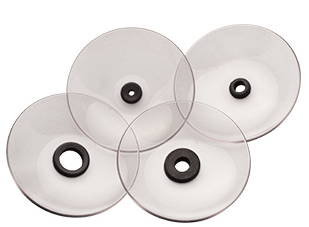
 

The Precision, VariBlast, Soft Grip and Heavy Duty Safety Air Guns are ALL available with an optional, polycarbonate Chip Shield to protect personnel from flying chips and debris, further meeting OSHA Standard 1910.242(b) for the safe use of compressed air.


Lastly we offer our Super Blast Safety Air Guns. The Super Blast Safety Air Guns are ideal for wide area blowoff, cooling or drying a part, as well as long distances. They feature a comfortable foam grip and spring loaded valve that will shut off the airflow if the gun is dropped. These units use our larger Super Air Nozzles and Super Air Nozzle Clusters, providing forces levels from 3.2 lbs. up to 23 lbs. Depending on which nozzle is fitted on the assembly, air inlets will range from 3/8 FNPT up to 1-1/4 FNPT. Aluminum extensions are available in 36″ or 72″ lengths.


For help selecting the best product to fit your particular application, please contact one of our application engineers for assistance.

Justin Nicholl
Application Engineer
justinnicholl@exair.com
@EXAIR_JN


ROI – Return on Investment

Return on Investment (ROI) is a measure of the gain (preferably) or loss generated relative to the amount of money that was invested.  ROI is typically expressed as a percentage and is generally used for personal financial decisions, examining the profitability of a company, or comparing different investments.  It can also be used to evaluate a project or process improvement to decide whether spending money on a project makes sense.  The formula is shown below-

ROI

  • A negative ROI says the project would result in an overall loss of money
  • An ROI at zero is neither a loss or gain scenario
  • A positive ROI is a beneficial result, and the larger the value the greater the gain

Gain from investment could include many factors, such as energy savings, reduced scrap savings, cost per part due to increased throughput savings, and many more.  It is important to analyze the full impact and to truly understand all of the savings that can be realized.

Cost of investment also could have many factors, including the capital cost, installation costs, downtime cost for installation, and others.  The same care should be taken to fully capture the cost of the investment.

Example – installing a Super Air Nozzles (14 SCFM compressed air consumption) in place of 1/4″ open pipe (33 SCFM of air consumption consumption) .  Using the Cost Savings Calculator on the EXAIR website, model 1100 nozzle will save $1,710 in energy costs. The model 1100 nozzle costs $37, assuming a $5 compression fitting and $50 in labor to install, the result is a Cost of Investment of $92.00. The ROI calculation for Year 1 is-

ROI2

ROI = 1,759% – a very large and positive value.  Payback time is only 13 working days.

Armed with the knowledge of a high ROI, it should be easier to get projects approved and funded.  Not proceeding with the project costs more than implementing it.

If you have questions regarding ROI and need help in determining the gain and cost from invest values for a project that includes an EXAIR Intelligent Compressed Air® Product, feel free to contact EXAIR and myself or one of our Application Engineers can help you determine the best solution.

Brian Bergmann
Application Engineer

Send me an email
Find us on the Web 
Like us on Facebook
Twitter: @EXAIR_BB

EXAIR Super Air Knives Helps Keep Labels on the Bottles.

Super Air Knife Blower Air Knife

Sometimes you need more power.  I received a phone call from a bottling facility that was currently using a blower style type of air knives.  They increased their production rate from 220 bottles/min to 300 bottles/minute, and they started to see issues in the labeling process.  Their operation consisted of a wash cycle, rinse cycle, drying cycle, then labeling.  They determined that the bottles were not getting dry enough during the drying cycle before the labels were applied.  They had a VFD (Variable Frequency Drive) for the blower system, and they reached the maximum rate.  Still the bottles were not getting dry enough to allow the label to stick to the surface properly.  This meant that they would have to increase the size of their blower system.  With the capital cost of a blower system, they decided to call EXAIR to see if we could help them with the drying application.

Compressed air is the best way for establishing a strong blowing force.  Instead of air pressures in the range of inches of water, the compressed air system can generate over 40 times the amount of pressure than a typical blower system.  EXAIR products uses this power of the compressed air to give you a wide range of blowing forces for drying, cooling, or moving products.  For the above application, I recommended two model 110212 Super Air Knife kits.  The kit includes the Super Air Knife, a filter, a regulator, and a shim set.  They mounted one knife on each side of the bottles to blow off and remove the liquid after the rinse cycle.  Even at the increased bottle speeds, the EXAIR Super Air Knives had no issues in keeping the bottles dry.  With the regulator and the shim, it was easy for them to dial in the correct amount of force without using excess compressed air.  The labels remained glued and the bottling process ran smoothly.  Because the company was impressed by the Super Air Knives, they wanted to comment on the comparisons between the blower knife and the Super Air Knife.

  1. Cost:
    1. Blower System – The reason for contacting EXAIR. Blower-type air knives are an expensive set up.  They require a blower, ducting, and a knife.  To have any flexibility, a control panel with a VFD will be needed.
    2. Super Air Knife – It is a fraction of the cost. With their system, we were roughly 1/10 the cost; even with the kit.  No capital expense report would be needed for the two air knives.
  2. Installation:
    1. Blower System – They stated that it took them a week to install the entire system before they were able to operate. They had to run electrical wires, controls, ducting, and they even had to change the conveying system slightly to accommodate the blower size.
    2. Super Air Knife – They mounted the filter and the regulator on the conveyor, and ran tubing to the Super Air Knives. Even with a fabricator making a bracket to fit into their system, they had the system up and running is less than two hours.
  3. Size:
    1. Blower System – The foot print of the blower is large and it takes up floor space. The 3” ducting had to be ran to an oversized air knife.  With the congestion of the bottle system, it made it difficult to optimize the position and the blowing angle to adequately dry the bottles.
    2. Super Air Knife – With the compact design, the Super Air Knife packs a large force in a small package. It has a footprint of 1 ¾” X 1 ½” X 12” long.  The air knife only required a ¼” NPT compressed air line to supply the compressed air.  It opened up the floor space as well as the bottling area.
  4. Maintenance:
    1. Blower System – The blower filter had to be changed regularly, and system had to be checked. Being that the blower motor is a mechanical device, the bearings will wear and the motor will fail over time.  These items should be checked quarterly as a PM which increase the cost to run the system.
    2. Super Air Knife – No moving parts to wear out. The only maintenance would be to change the filter once a year.
  5. Versatility:
    1. Blower System – They did have a VFD to control the blowing force. But it was still very limited.  With a 36% increase in the bottle speed, they went beyond the maximum capacity of the blower.
    2. Super Air Knife – With a regulator and the shim set, the blowing force can be controlled easily from a breeze to a blast. With their application, the customer only required 40 psig with a standard 0.002” shim to clean and dry the bottles.  They had the option to adjust the regulator or change the shim to get the appropriate amount of blowing force.  So, with any changes in the bottling operations, the Super Air Knife could easily be adjusted.  Also, with the blowing force being optimal from a distance of 3” to 12” from the target, they had more flexibility in angle and distance to hit the moving target.
  6. Quiet:
    1. Blower System – With the blower and turbulent air flow, the units are very loud. It had a sound level near 93 dBA, and with the operators working around the system, they needed PPE to protect them from the high potential of noise induced hearing loss.
    2. Super Air Knife – These units are very quiet. At 40 PSIG, the sound level is only at 61 dBA.  (Even operating at a pressure of 100 PSIG, the sound level is only 72 dBA).  This was very nice for the operators to work around as it wasn’t a constant noise nuisance.

In using the compressed air, the Super Air Knives are engineered to be very efficient.  The design creates a 40:1 amplification ratio which means that for every 1 part of compressed air, 40 parts of the ambient air is entrained.  But, even with the use of compressed air, the customer still wanted to share the ease of installing, the effectiveness of blowing, and the improvements to their process.  With the 6 points noted above, the customer wished that they would have contacted EXAIR at the beginning.

John Ball
Application Engineer
Email: johnball@exair.com
Twitter: @EXAIR_jb

Vortex Tube Cold Fractions – An Explanation

Vortex Tube Family

At EXAIR we’ve been a pioneer in the compressed air market for the past 34 years.  We’ve brought engineered nozzles to the market which reduce compressed air consumption while maintaining performance, laminar flow Air Knives, pneumatic conveyors, atomizing nozzles, air-assisted static eliminators, and a slew of other products.  One of these “other” products is our Vortex Tube, which we manufacture in various sizes while also using as a basis for our Cold Guns, Adjustable Spot Coolers, Mini Coolers, and Cabinet Coolers – all of which are built on the same Vortex Tube technology.

Theory of operation for an EXAIR Vortex Tube

The principle behind a Vortex Tube is rooted in the Ranque-Hilsch effect which takes place inside of the tube.  As a compressed air source is fed into the Vortex Tube, the air flows through a generator and begins to spin down the length of the tube, “hugging” the ID of the tube.  When this spinning air contacts a deliberate obstruction at the end of the tube, it is forced to reverse directions, which requires a change in diameter to the vortex.  The original vortex must decrease in diameter, and in order to do so, it must give off energy.  This energy is shed in the form of heat, and a portion of the incoming air is directed out of the tube with a drastically reduced temperature via what is called the “cold end”.  Another portion of the air escapes through the “hot end” of the tube, resulting in a cold airflow at one end, and a hot airflow at the other end of the tube.

Small, but powerful, Vortex Tubes really are a marvel of engineering.  And, like most useful developments in engineering, Vortex Tube technology begs the question “How can we control and use this phenomena?”  And, “What are the effects of changing the amount of air which escapes via the cold end and the hot end of the tube?”

EXAIR Vortex Tube Performance Chart

These answers are found in the understanding of what is called a cold fraction.  A cold fraction is the percentage of incoming air which will exhaust through the cold end of the Vortex Tube.  If the cold fraction is 80%, we will see 80% of the incoming airflow exhaust via the cold end of the tube.  The remaining airflow (20%) will exhaust via the hot end of the tube.

For example, setting a model 3210 Vortex Tube (which has a compressed air flow of 10 SCFM @ 100 PSIG) to an 80% cold fraction will result in 8 SCFM of air exhausting via the cold end, and 2 SCFM of air exhausting through the hot end of the Vortex Tube.  If we change this cold fraction to 60%, 6 SCFM will exhaust through the cold end and 4 SCFM will exhaust through the hot end.

But what does this mean?

Essentially, this means that we can vary the flow, and temperature, of the air from the cold end of the Vortex Tube.  The chart above shows temperature drop and rise, relative to the incoming compressed air temperature.  As we decrease the cold fraction, we decrease the volume of air which exhausts via the cold end of the Vortex Tube.  But, we also further decrease the outlet temperature.

This translates to an ability to provide extremely low temperature air.  And the lower the temperature, the lower the flow.

Red box shows the temperature drop in degrees F when an EXAIR Vortex Tube is operated at 100 PSIG with an 80% cold fraction.

With this in mind, the best use of a Vortex Tube is with a setup that produces a low outlet temperature with good cold air volume.  Our calculations, testing, and years of experience have found that a cold fraction of ~80% can easily provide the best of both worlds.  Operating at 100 PSIG, we will see a temperature drop of 54°F, with 80% of the incoming air exiting the tube on the cold end (see red circle in chart above).  For a compressed air supply with a temperature of 74°F-84°F (common compressed air temperatures), we will produce an output flow with a temperature between 20°F and 30°F – freezing cold air!

With a high volume and low temperature air available at an 80% cold fraction, most applications are well suited for this type of setup.  When you order a Vortex Tube from EXAIR we will ship it preset to ~80% cold fraction, allowing you to immediately install it right of the box.

The cold air from an EXAIR Vortex Tube is effective to easily spot cool a variety of components from PCB soldering joints to CNC mills, and even complete electrical control panels.  Contact an Application Engineer with application specific questions or to further discuss cold fractions.

Lee Evans
Application Engineer
LeeEvans@EXAIR.com
@EXAIR_LE