Comparing and Combining Sound Levels

Sound levels are an important safety consideration in most industrial facilities. OSHA has guidelines on allowable noise levels and exposure, covered in OSHA Standard 29CFR – 1910.95 (a). Sound levels are measured in decibels, or dB. It makes sense that a higher decibel value means a louder sound (as illustrated in the graphic below). What is not intuitive is how multiple sound levels interact and combine, or how they compare to one another.

The first thing to understand about sound levels is that they aren’t measured on a linear scale. Instead, they’re measured on a logarithmic scale. This can really throw off our intuition. For instance, a sound at 20dB is actually 10 times stronger than one at 10dB, and a sound at 30dB is 100 times stronger than 10dB. If it were a linear scale, 20dB and 30dB would only be 2 and 3 times stronger than 10dB, similar to how mass works—like 20kg being double the mass of 10kg.

You can see why this is the case with the formula for calculating sound levels, which is as follows:

It’s important to note that the sound pressure levels calculated using this formula are unweighted. To really grasp how loud something will seem to us, we have to consider how our ears pick up various frequencies. This means that low and extremely high frequencies are given less weight than on the standard decibel scale. This adjusted measurement is referred to as dBA. You can check out some typical sounds and their dBA levels in the chart below:

Because of this logarithmic scale, combining two sounds can be pretty counter-intuitive too. Our Model 1100 Super Air Nozzle generates a sound level of 74 dBA, but when you place two of them side by side, the sound level jumps to 78 dBA (and not 148dBA). This is determined using the formula below:

The specifics of this calculation are explained in this blog here, but OHSA provides a quick and easy way to calculate, as shown in the table below:

To see if you need to tackle the noise levels in your facility, you should start by taking a baseline measurement of the different processes and devices that are making the noise. EXAIR’s Sound Level Meter, Model 9104, is here to help. It’s super user-friendly and gives you a digital readout of the sound level (no need to deal with logarithms!).

If you would like to discuss sound levels in your facility, or any of your other compressed air needs, give us a call!

Al Wooffitt
Application Engineer

Send me an Email
Find us on the Web
Like us on Facebook
Twitter: @EXAIR_AW

Who Wants to Save on Compressed Air?

At EXAIR we pride ourselves on helping our customers optimize their compressed air usage. Our intelligent compressed air products are engineered to be quiet and efficient, saving you on compressed air consumption. This is just one of the six steps that we recommend in order to optimize your compressed air system.

The first step we would recommend is to measure your air consumption. If you are going to attempt to reduce air consumption in your facility, it is necessary to know what is using it. If you know the consumption of your compressed air-operated products, you can make note of this. A more comprehensive solution would be to install some of our Digital Flowmeters in branch lines in your facility. The flow data provided by this will help you narrow down the high consumption areas and processes.

The second step we would suggest is to find and fix leaks. Our Ultrasonic Leak Detector is perfect for this. According to the Compressed Air and Gas Institute, leaks should not exceed 5-10% of your system’s air supply (we would obviously want 0%, but realistically this is unachievable). However, it is not uncommon to see leaks account for over 30% of many facilities’ compressed air supply being lost through leakage. That’s a potential for a 25% gain in compressed air supply!

The third step would be to upgrade your blowoff, cooling and drying operations using engineered compressed air products. All of EXAIR’s products, like our Super Air Knives, or Super Air Nozzles, are designed with efficiency in mind. Upgrading to an efficient EXAIR product is going to reduce your consumption, sometimes dramatically so!

The fourth step is to turn off your compressed air when not in use. This may sound obvious, but it is not uncommon for compressed air products to be left running continuously. We offer many solutions here, from a simple ball valve (found in many of our Drum Vac Kits), to a solenoid valve (found in our Cabinet Cooler Systems), to our Electronic Flow Controllers – combining a solenoid valve and photoelectric sensor.

The fifth step would be to use intermediate storage near the point of use. If you are controlling your compressed air usage through the use of valves and controls, then your consumption won’t be constant. This fluctuation in demand can be evened out with the use of secondary storage, like our Model 9500-60 Receiver Tank. This will ensure you have the volume and pressure when and where you need it.

Finally, our sixth step is to control the operating pressure. More specifically, to reduce the pressure to the minimum required to get the job done. Simply installing a pressure regulator at the point of use will lead to big savings.

If you would like to start optimizing your compressed air system, then give me a call!

Al Wooffitt
Application Engineer

Send me an Email
Find us on the Web
Like us on Facebook
Twitter: @EXAIR_AW

Just Needs A Little More To The Left

I’ve come across many applications where customers run multiple different parts or products along the same line, and each requires some form of blowoff before moving to the next stage. Too often, a system designed for just one specific part can’t keep up with the variations. Sometimes the “solution” ends up being to crank up the compressed air, which is wasteful and inefficient.

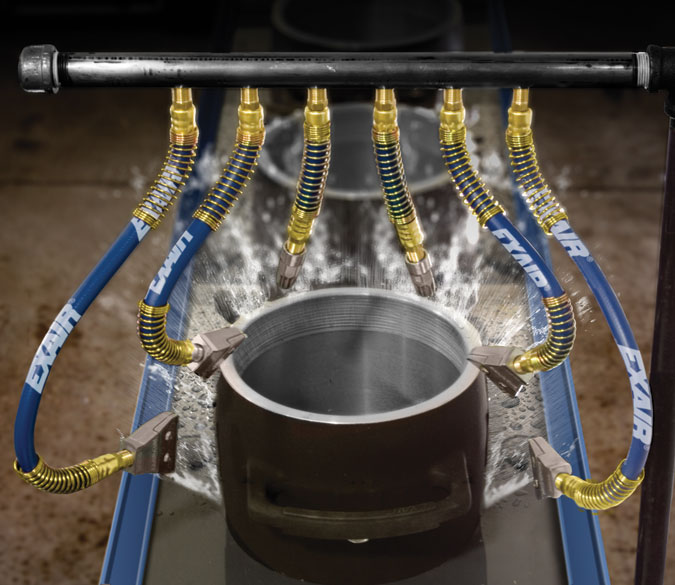
Instead of increasing air pressure or fabricating new mounts every time there’s a changeover, consider installing EXAIR’s Stay Set Hoses or Swivel Fittings.

            Stay Set Hoses are flexible and hold their shape once positioned, making them ideal for quickly adapting to different parts on the line. Available in 1/8″ and 1/4″ MNPT fittings (or a mix of both) and various lengths, these hoses can support anything from a Nano Super Air Nozzle to a Super Air Amplifier—or even a Super Air Knife. Repositioning them is easy: just bend the hose by hand to aim the airflow exactly where it’s needed for the new part.

                Swivel Fittings may be a better fit if your application doesn’t require much flexibility but still needs occasional fine-tuning. These allow up to 25 degrees of movement off axis, are made of durable 303 stainless steel, and help you easily refocus nozzles without a full tear down.

If your blowoff system isn’t keeping up with your line changes, it might be time to explore how Stay Set Hoses and Swivel Fittings can bring efficiency and adaptability to your process.       

Brian Farno, MBA – CCASS Application Engineer

BrianFarno@EXAIR.com
@EXAIR_BF

More About Compressed Air Safety

We all know how crucial safety is in the workplace. Most companies conduct some type of annual safety training, and a key takeaway from these sessions is that safety isn’t just the job of a few individuals; it’s everyone’s responsibility. At EXAIR, we take safety very seriously. Many of our products are designed with safety as a priority, including our Safety Air Guns, which highlight our commitment to this principle. This focus is essential because using compressed air can pose health risks if not handled correctly.

In the U.S., OSHA (Occupational Safety and Health Administration) is the agency that enforces regulations to ensure safe and healthy work environments. They have the authority to impose hefty fines for any violations. When it comes to compressed air, two common violations involve air guns and blow-off devices, as outlined in 29CFR 1910.242(b) regarding dead-end pressure/chip shielding and 29CFR 1910.95(a) concerning maximum noise exposure limits.

The first regulation, 29CFR 1910.242(b), pertains to hand-held tools. It specifies that blow-off devices should not be used at pressures exceeding 30psig if the compressed air can become dead-ended. If there’s no escape route for the air, it can penetrate the skin and lead to an air embolism. A straightforward solution is to drill a hole to provide an alternate escape path, although this can introduce other safety concerns, which we’ll cover later. EXAIR’s air nozzles are designed with fins that allow air to escape safely, preventing blockage by your skin. This means you can confidently use the EXAIR Super Air Nozzles at pressures above 30psig.

The second regulation, 29CFR 1910.95(a), outlines the maximum sound levels that a person can safely be exposed to. Prolonged exposure to high sound levels can lead to permanent hearing damage. This is where the cross-drilled nozzle doesn’t quite meet the mark. While it’s safe for dead-end pressure, the noise from the turbulent airflow is quite loud. In contrast, EXAIR’s nozzles are designed to pull in surrounding air, creating a much quieter laminar flow. For instance, our Model 1210 Safety Air Gun, which features the Model 1100 Nozzle, operates at just 74dBA, well below the noise exposure limit for an 8-hour shift.

Model 1210 Soft Grip Safety Air is fitted with an EXAIR Super Air Nozzle. We can also supply it with a Rigid Extension and Chip Shield (right).

If you’re serious about compressed air safety, EXAIR’s range of safe, quiet, and efficient Safety Air Guns and Air Nozzles is an excellent option for your facility. Feel free to reach out if you want to chat about this or any other compressed air applications you might have!

Al Wooffitt
Application Engineer

Send me an Email
Find us on the Web
Like us on Facebook
Twitter: @EXAIR_AW

Banner image by Gerd Altmann from Pixabay